Manufacturing and industrial

Your agents, from the formula to the floor.Built on Meibel, your way.

Data sheets, supplier certificates, price lists, equipment manuals and maintenance standards. Each job gets its own tool or a reread by hand. On Meibel your team builds the agents for all of them, on one read of every document, in whatever format it arrived.

Free to start. No credit card.

The work today

Every stage of the plant runs on documents.Each job gets checked its own way.

A point tool for one job, a spreadsheet for the next, a reread by hand for the rest. None of them share what the documents say.

Design
  • Product data sheets
  • Formulas
  • Specs

TodayEvery data sheet checked against the formula by hand.

Source
  • Supplier price lists
  • Quotes
  • Contracts

TodayPrice lists in every format retyped into one spreadsheet.

Make and check
  • Certificates of analysis
  • Safety data sheets
  • Test records

TodayEach certificate checked against the spec, one at a time.

Maintain
  • OEM manuals
  • Parts lists
  • Maintenance standards
  • Work orders

TodayParts lists built by hand from thousand-page manuals.

Nothing shares what the documents say
We have about 40,000 documents, and we don't know how many formats are in there.
A product data team
Sometimes they're electronic, sometimes they're a piece of paper printed out with the shipment.
A supplier quality team, on certificates
Typically, we would spend time manually sifting and combing through the documents, creating parts lists.
A maintenance services team

One platform

Read every manual and sheet once.Build every agent on it.

Meibel does the data engineering: how to read each document type, store it and retrieve it. Your team writes the agents, with your rules, and runs them where your teams already work.

Meibel handles the data. You build the agents.

Agents across the plant

Start with one agent.Add the next on the same data.

The jobs manufacturing and industrial teams bring to us, from design to maintenance. Each one is an agent you build on Meibel, your way.

Design and source

  • Data sheets that agreeProduct, technical and safety data sheets for one product, checked against each other and the formula.
  • Decades of formulas, searchableProduct and formula history you can ask about, instead of digging through it by hand.
  • Supplier pricing, normalizedPrice lists in any format and language, side by side in one table.

Make and check

  • Certificates of analysisEvery supplier certificate checked against your spec, with trends across lots.See the use case
  • Safety data sheet conflictsThe same chemical classified differently by two suppliers, caught.
  • Legacy records, digitizedDecades of test cards and drawings, typed or handwritten, turned into data you can search.

Maintain and support

  • Parts lists from OEM manualsThe right list for each serial number, with every change between them.See it built
  • Where a part is usedEvery assembly that uses a part, and how many one machine needs.See the answer
  • Maintenance job plansWhat's due, how often and why, for the condition your equipment is in.See it built
  • Answers for support engineersTroubleshooting answers from equipment manuals and diagrams, with the page.

Running on two public maintenance manuals, below.

See it built

Three agents. One read of the manuals.Each answer cited to the page.

Three agents on two public manuals: a 421-page forklift parts list and a 167-page electrical maintenance standard, read once. Each answer is scored for grounding in that data.

Where Used FinderData grounding 0.87

Where is hose clamp F101150 used, and how many does one forklift need? Give each figure, item, quantity and SMR code.

Four assemblies, not alternatives. One forklift needs 10 clamps.

Figure (pages)Item and quantitySMR code
20, Fuel pumps and lines (0002-65 to 67)Quantity 4. Item number not in the extractPAOZZ
22, Fuel tank and lines (0002-73)Item 7, quantity 4PAOZZ
67, Front axle assembly and mounting (0002-183 to 184)Item 45, quantity 1PAOZZ
69, Rear axle assembly and mounting (0002-191 to 192)Item 45, quantity 1PAOZZ

PAOZZ, read by position: stocked, replaced at unit level, not repairable

Built on Meibel

Manufacturers and the teams that serve them, on Meibel.

SMS · Maintenance services100%

SMS turns thousand-page equipment manuals into maintenance data: 100% on most of their own tests, 90%+ overall, up from 70–95%.

Read the case study
A Fortune 200 manufacturerSeveral teams, one platform.

Teams across a Fortune 200 manufacturer build their agents on one Meibel platform, each on its own documents.

What we hear from manufacturersOther tools asked for clean data first.

Their documents span decades and thousands of formats, scans and handwriting included. Tools that needed clean, templated input never got started. Meibel starts from the documents as they are.

Run it at scale

Refine it on one manual.Run it on every machine you maintain.

The scale comes two ways: one agent over every manual, sheet and certificate you work with, and many agents over the same data without reloading the files.

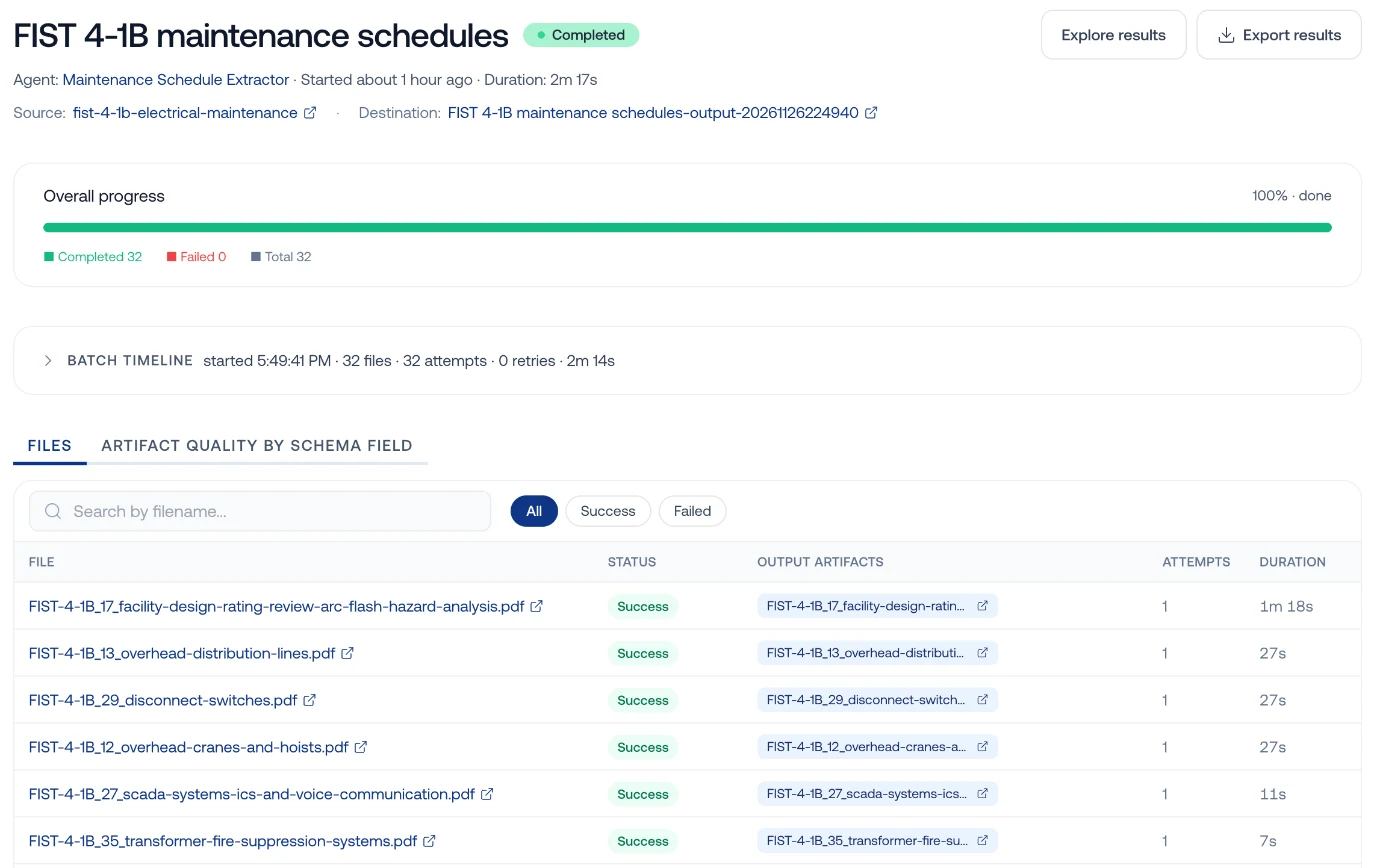
The FIST 4-1B maintenance schedules batch in Meibel: completed, 32 of 32 files, from the standard into the schedule output, every file marked Success.

One agent, every machine

A new manual is its files plus one batch.

The same schema and extractor fill the same table for every manual, model and revision, in parallel. Our guardrails, we call them Hardrails, scope each session to one plant or fleet. Built for millions of documents.

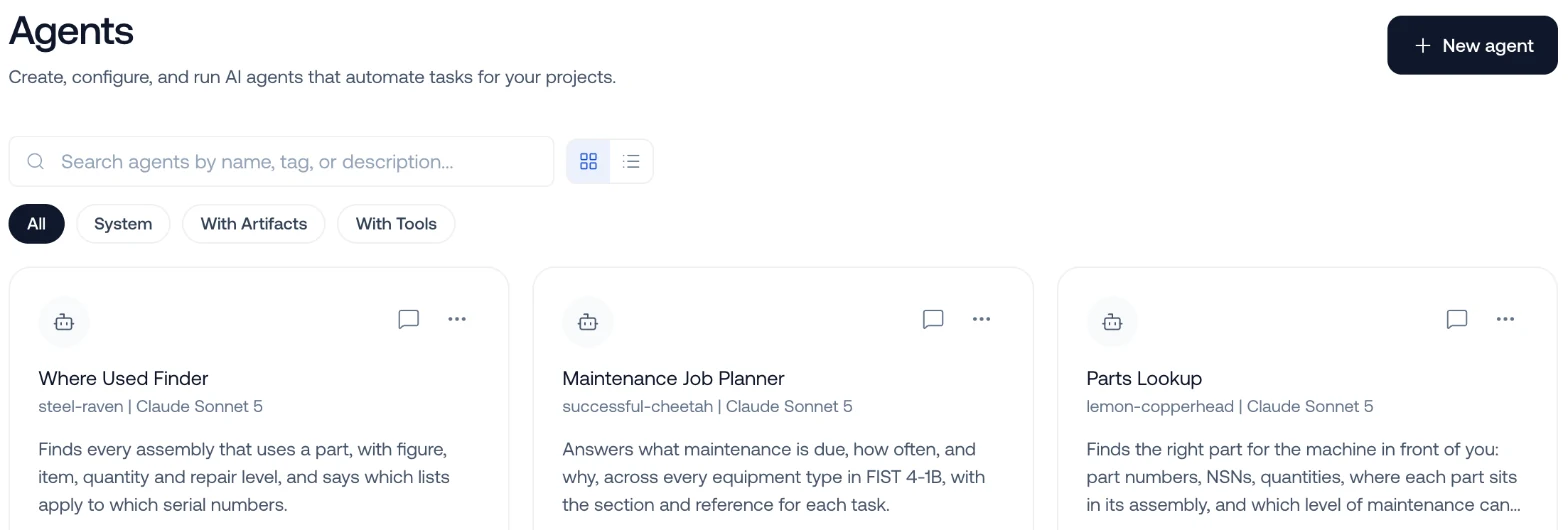
The Industrial Maintenance project in Meibel with three agents on Claude Sonnet 5: Where Used Finder, Maintenance Job Planner and Parts Lookup.

Many agents, one read

Every agent starts from the same data.

Meibel reads the manuals once, and the extractors fill the parts and schedule tables. The Where Used Finder and Parts Lookup share the parts table, the Job Planner reads the schedules, and the next agent attaches the same data.

Why Meibel here

Not one more point tool.The platform your agents run on.

Instead ofA point tool for each job

One job, set up the way its vendor thought it should work.

On Meibel

Every job your way, from one read of the documents.

Instead ofA general-purpose assistant

Answers that change from run to run, and someone still checks every line.

On Meibel

The same answer every time, cited to the page and scored.

Instead ofA document-processing tool

Clean, templated input first, and your team still builds the record.

On Meibel

Your documents as they are, in your schema, ready for every agent.

Your team owns the agents and the rules. Meibel handles the data.

How to start

Start with one manual you know well.Then add the next agent.

Pick one job

The parts and intervals in an equipment manual, or a month of supplier certificates. You already know the answer.

Build the agent

Load the documents, write the job and run it on all of them.

Measure it

Against what your team found: what it caught, what it missed, how confident it was, and how long it took.

Start with one workload. Scale efficiently.

Try Meibel

Build your first plant agent.Start with a manual you know.

Load one job, build one agent and measure it. Then add the next one on the same data.

  • Every manual and sheet, read once.
  • Every agent your team needs.
  • Scoped to each plant or fleet.
  • Every answer cited and scored.

Questions

What manufacturers ask first.

Who owns the agents?

You do. Your team writes the instructions, picks the model, chooses the data each agent can reach and decides what a low score triggers. Meibel handles the data underneath.

How many agents can we build on the same documents?

As many as the work needs. Every agent attaches the same data source and starts from it, without going back to the original files.

Which documents can it read?

Equipment and parts manuals, safety and technical data sheets, specs, certificates of analysis, work instructions, drawings, price lists and work orders, as PDF, scans, Word or Excel, in 25+ formats. Handwritten records too. Native CAD files aren't supported.

Do we have to clean up our data first?

No. Meibel reads your documents as they are, across formats and suppliers. You define the fields you need in a schema, and Meibel finds them in every format.

Can results go into our ERP or maintenance system?

Yes. Agents send results to your ERP, maintenance system or your own apps through tools, and answer in Copilot, Claude or your apps.

Is our data secure?

Meibel is SOC 2 Type II and HIPAA compliant. Run it in Meibel Cloud, a dedicated data plane or your own infrastructure.

How do we know an answer is right?

Every answer cites the document and page, and carries a score on the checks you choose. You decide what a low score triggers.

PALETTE