Every layer · Confidence Scoring
Every answer scored.From the page to the answer.
Know which answers to rely on. Meibel scores every page read, every field extracted, every tool call and every answer.
Why score every answer
Two identical answers.
Only one tells you how good it is.
An answer without a score has to be checked by hand, every time. The same answer with its scores and its source can be relied on, or checked exactly where it's weak.
Check it by hand. Every time.
Rely on it, or look exactly where it's low.
ILLUSTRATION · SAMPLE PROJECT · FREIGHT AUDIT
Scored at every layer
From the page
to the answer.
A wrong answer can start anywhere: a misread page, a field pulled from the wrong row, a weak retrieval, the wrong tool. Meibel scores each layer, so you know where.
Each word on the faxed delivery receipt carries how sure the reader was. "1?:40" scores 0.41.
Document Intelligence →Every extracted field is checked against the source document. detention_rate = $41.00 is supported on p.12.
Deep Transformation →How much of the answer is backed by the passages and rows the agent retrieved: 0.86.
Retrieval-Ready Data →Structured query for the rate, search for the rule, the page to check. Tool use 9 / 10.
Tools and Integrations →Correctness 9: the $41 rate and two billable hours match tariff p.12. Completeness 6: the other invoices on the lane weren't mentioned.
Agent Builder →YOU CHOOSE WHICH CHECKS TO ENABLE. EACH STEP RUNS ONLY THE CHECKS THAT FIT IT.
Two kinds of check
A judge that explains itself.
A measure against the source.
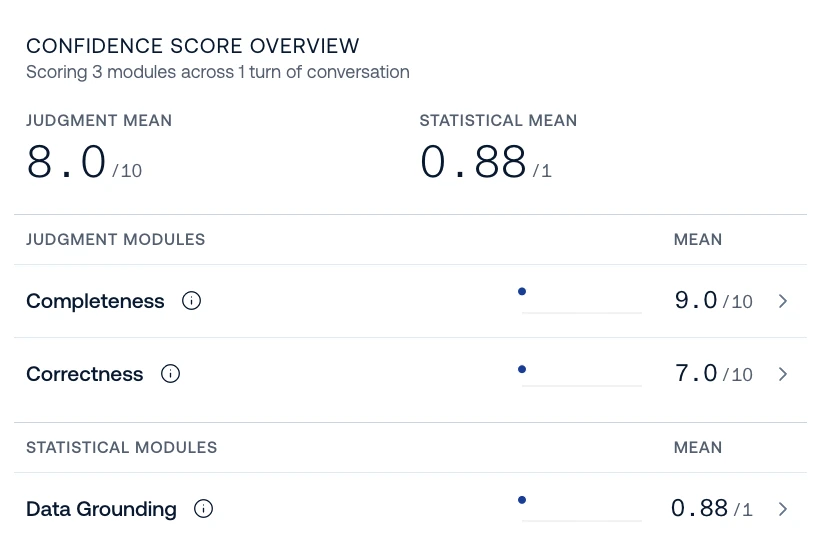
Judged checks score the work 0 to 10 with a written reason. Measured checks score 0.0 to 1.0 against the source. Or write your own.
 12
- 1
Judged, 0 to 10.
Completeness and correctness, each scored with a written reason, so you know what to fix.
- 2
Measured, 0.0 to 1.0.
Data grounding, computed against what the agent retrieved.
Real console · sample project · one freight audit answer
See every step scored on your own files.
Choose the checks, then decide what a low score triggers.
Was it the agent, or its tools?
Two scores tell you
what to fix.
Tool Usage scores how the agent used its tools. Tractability scores whether the tools fit the task. Read together, they point at the fix.
Add a tool.
The agent used its tools well. They can’t cover the task.
Ship it.
The tools fit the task, and the agent used them well.
Start with the tool set.
A gap often forces bad calls. Fix the tools, then measure again.
Fix the agent.
The tools fit. Check its instructions, model or tool descriptions.
Out of the way
The agent answers.
The scores catch up.
Scoring runs alongside the agent, not in its path. The answer comes back at full speed, and each check posts its score when it finishes.
ILLUSTRATION
What a low score triggers
You set the threshold.
You decide what happens.
Scores don't act on their own. Add a gate or a tool that reads them, and a low score waits for a person while everything above your threshold keeps moving.
ILLUSTRATION · SAMPLE RULES
Across every run
Compare versions
by their scores.
Every run shows its weakest check. Compare a draft with what's published before you switch, and watch for drift.
ILLUSTRATION · SAMPLE AGENT
Built on Meibel
Teams already ship on it.
Meibel's Generative AI platform has unlocked the full potential of SINE, our foresight analysis and scenario product. The Confidence Framework builds trust and transparency into SINE’s AI-driven insights that empowers our customers to confidently navigate complex strategic planning.
We use Meibel to integrate generative AI into our SaaS product Specbooks+. We replaced thousands of lines of code and multiple other tools with better, measurable results.
Questions
Which checks run?
The ones you enable on each agent. At every step, the platform runs only the checks that fit it, so page checks run on parsed pages and tool checks run when the agent has tools.
Does scoring slow the agent down?
No. Scoring runs alongside the agent, outside its path. The answer returns first, and scores post as each check finishes.
Are judged and measured scores averaged?
Never. A judged 7 and a measured 0.7 measure different things.
Can we write our own check?
Yes. A custom judge scores the work against your own criteria and prompt.
What happens on a low score?
You decide. Add a gate or a tool that reads the score, and the item waits for a person with its source page beside it.
Where do we see the scores?
In the console and through the API: every score with its reason, a summary for each run, and a breakdown by check.
Start with one workload. Scale efficiently.
Refine it on one document. Run it on millions.
Sign up free and build an agent on one real document. Then run one real process at your real volume and measure it against what your team already knows is right.