AGENTS
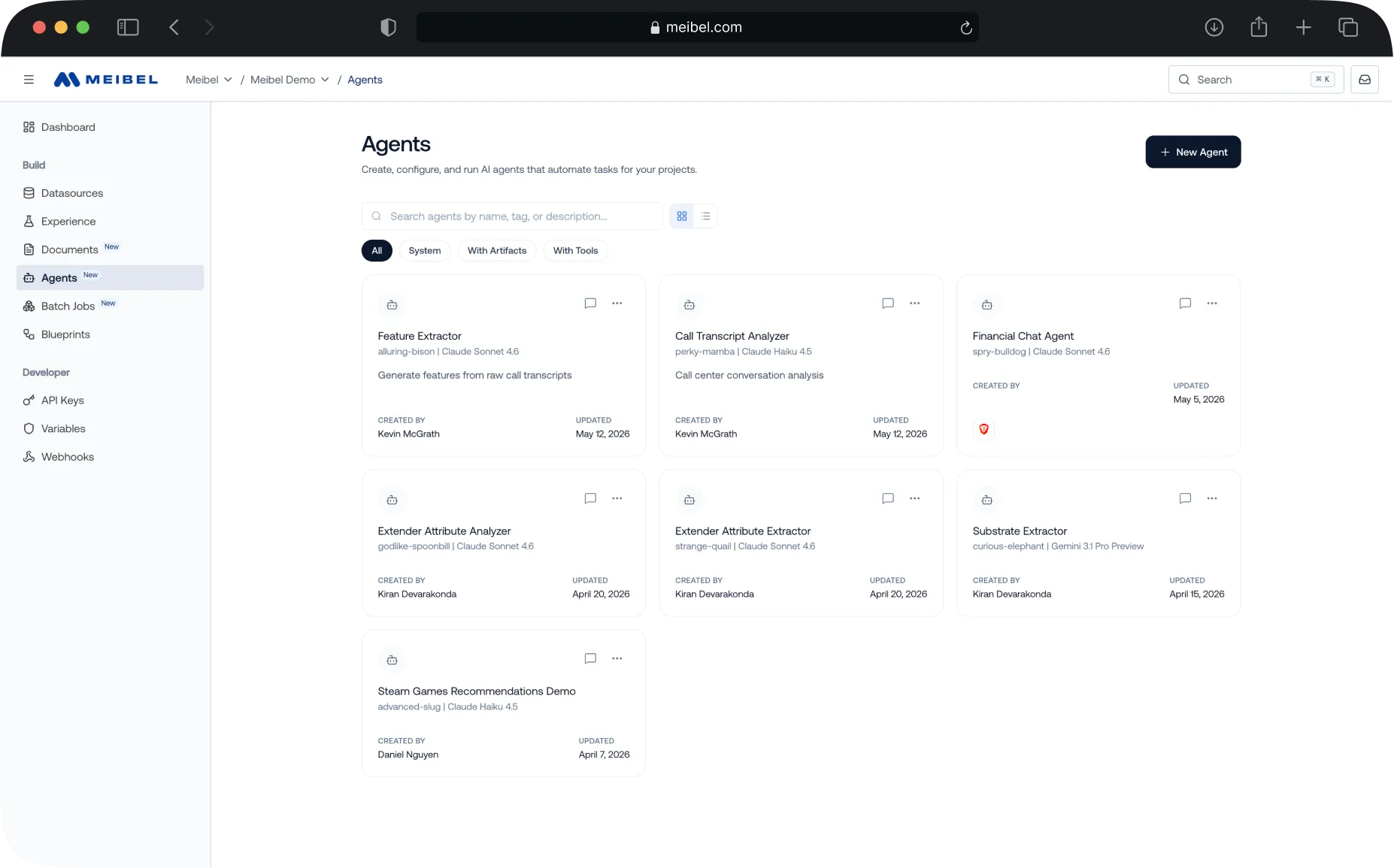
Meibel agents reason over your private data, call your tools and APIs, produce structured outputs, and score every result for quality. Define an agent once. Run it on one item or a million.



WHY AI WORKFLOWS BREAK
Teams build agents that work in demos. Then they hit real data, real scale, real users, and the system breaks in predictable ways.
The agent retrieves text fragments instead of full document context. Tables are flattened. References are lost. Structured and unstructured data live in separate systems with no way to query across both.
Prompt chains break silently. There is no version of the whole configuration, so a change that made things worse cannot be reverted, only argued about. Every format change means engineering rework.
There is no quality score on the output. No way to route high-confidence results to automation and low-confidence results to review. Teams either review everything or accept everything. Neither scales.

Agents are the execution layer. They are versioned, reproducible definitions that combine instructions, connected data sources, attached tools, model selection, and a structured output schema into a single deployable unit.
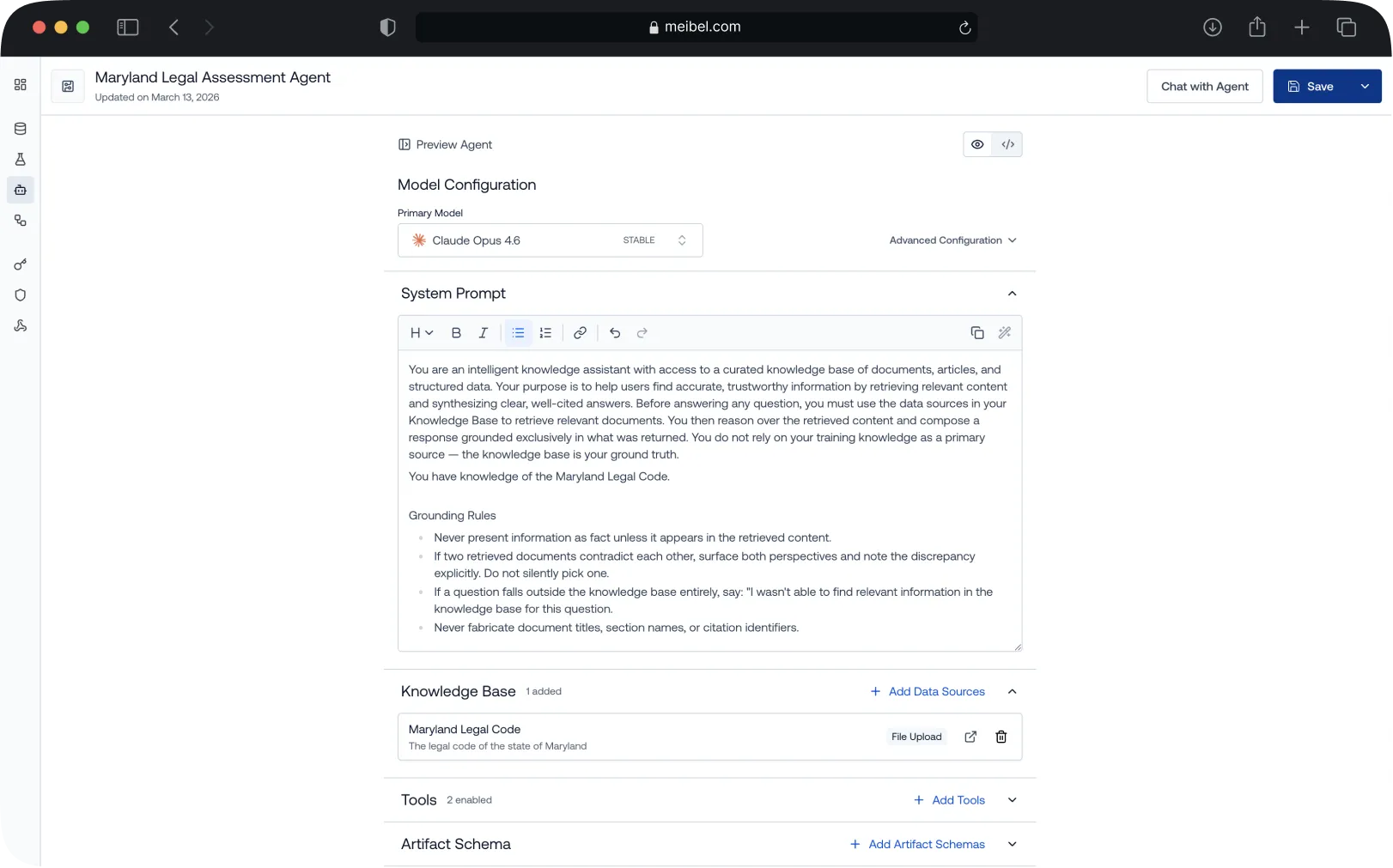
Agents are most powerful when grounded in your private data. A bound datasource gives an agent three retrieval modes and lets it choose: a document-search tool over the unstructured content, a structured-query tool over its tables, and graph traversal across the citations and cross-references that connect documents to each other. It can combine all three in one answer. Agents also connect to external systems and tools through MCP. The data source does not limit what the agent can do.
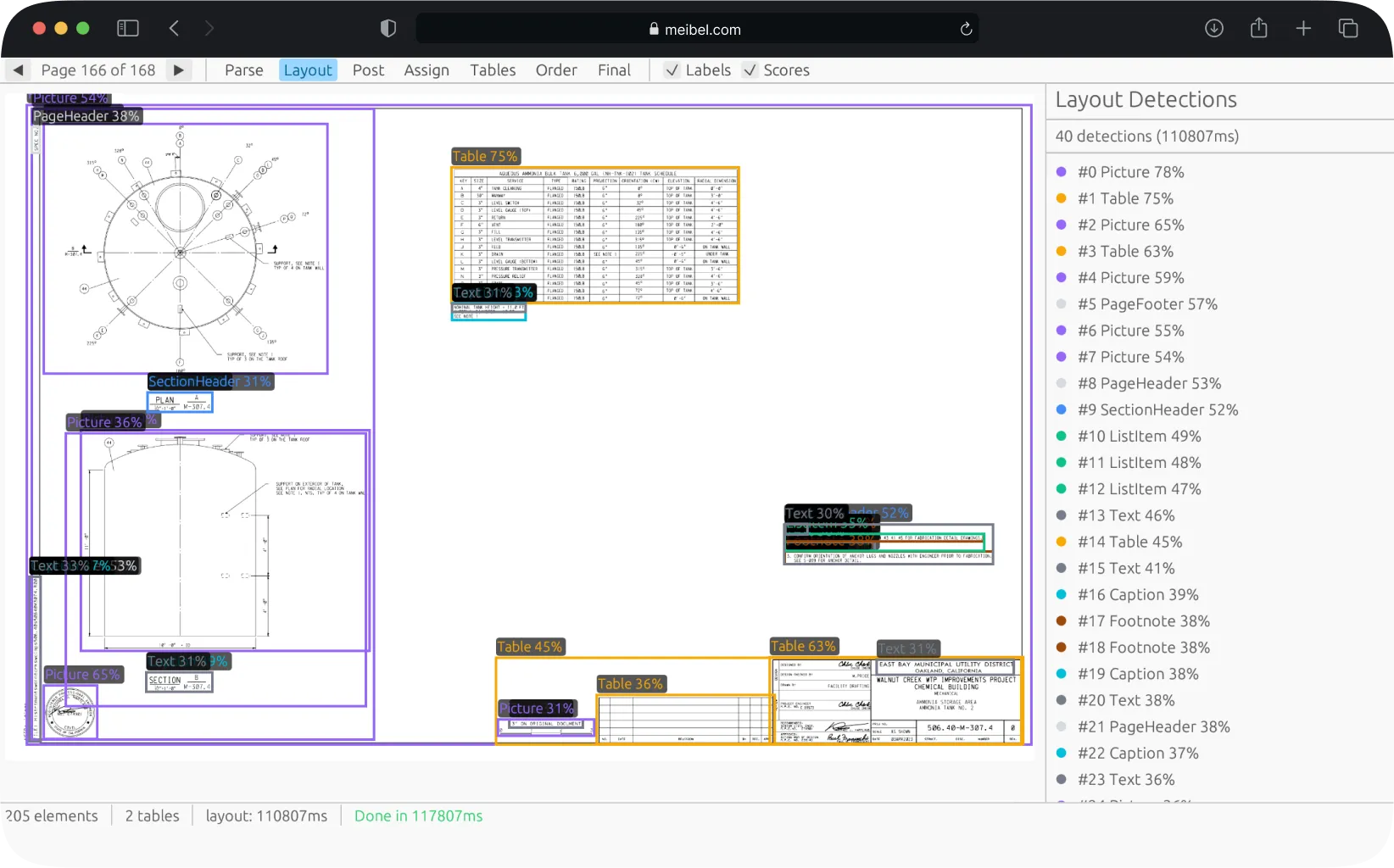
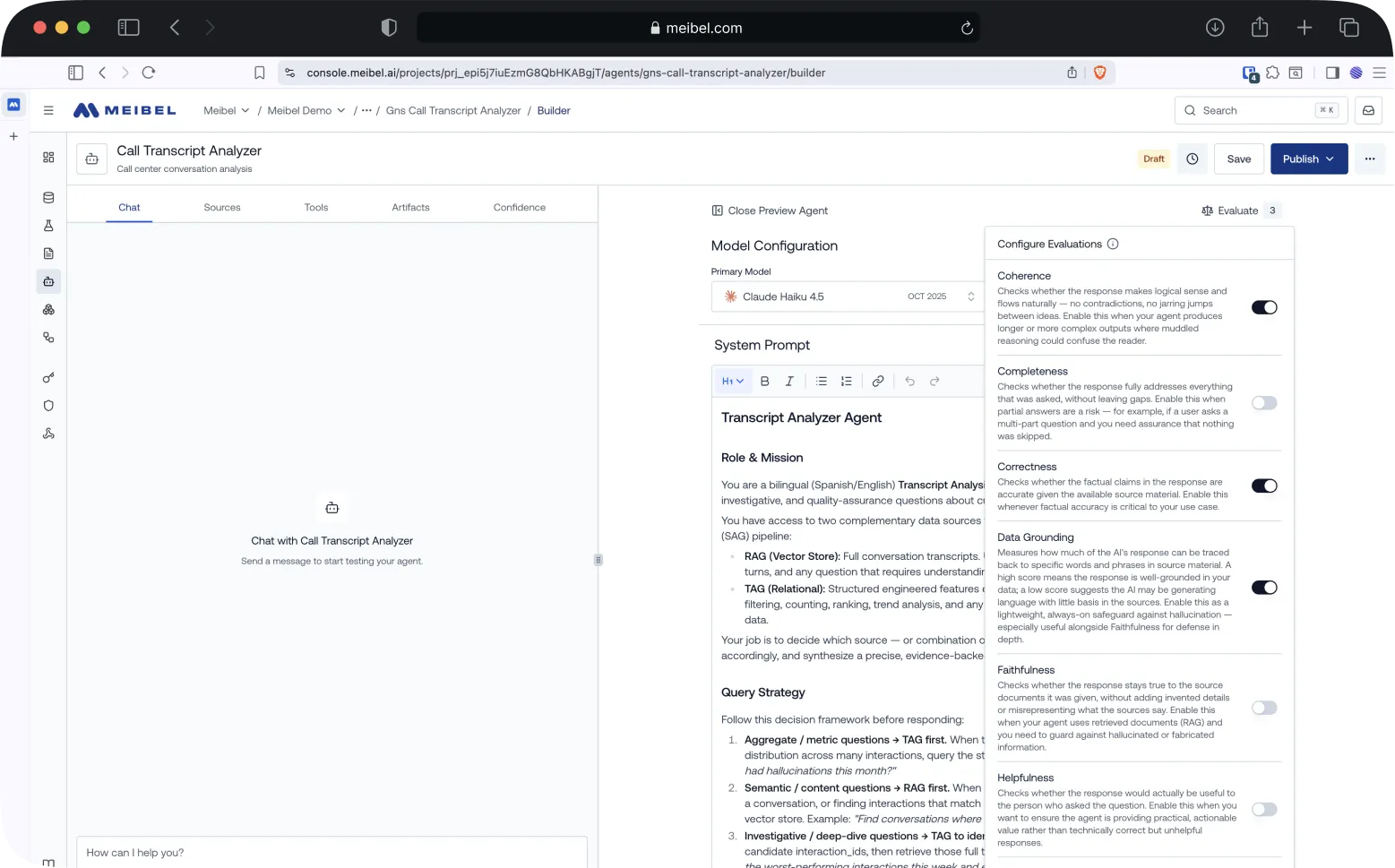
Confidence scoring is not a dashboard you check after the fact. It is integrated into execution and runs in background jobs outside the execution path, so enabling it does not slow the responses the agent returns. Judged modules score 0 to 10 and return a written explanation of why. Statistical modules compute 0.0 to 1.0 from the data. The platform never averages across them and applies only the modules that fit the step being performed. Scores drive routing: high confidence goes to automation, low confidence is flagged, escalated, or blocked.
Tool activity records which datasources were searched, what queries were used, and what results came back. Because the version is immutable, you know exactly which configuration produced the run. In batch, transient failures retry automatically and anything still failing is rerun in a targeted execution.
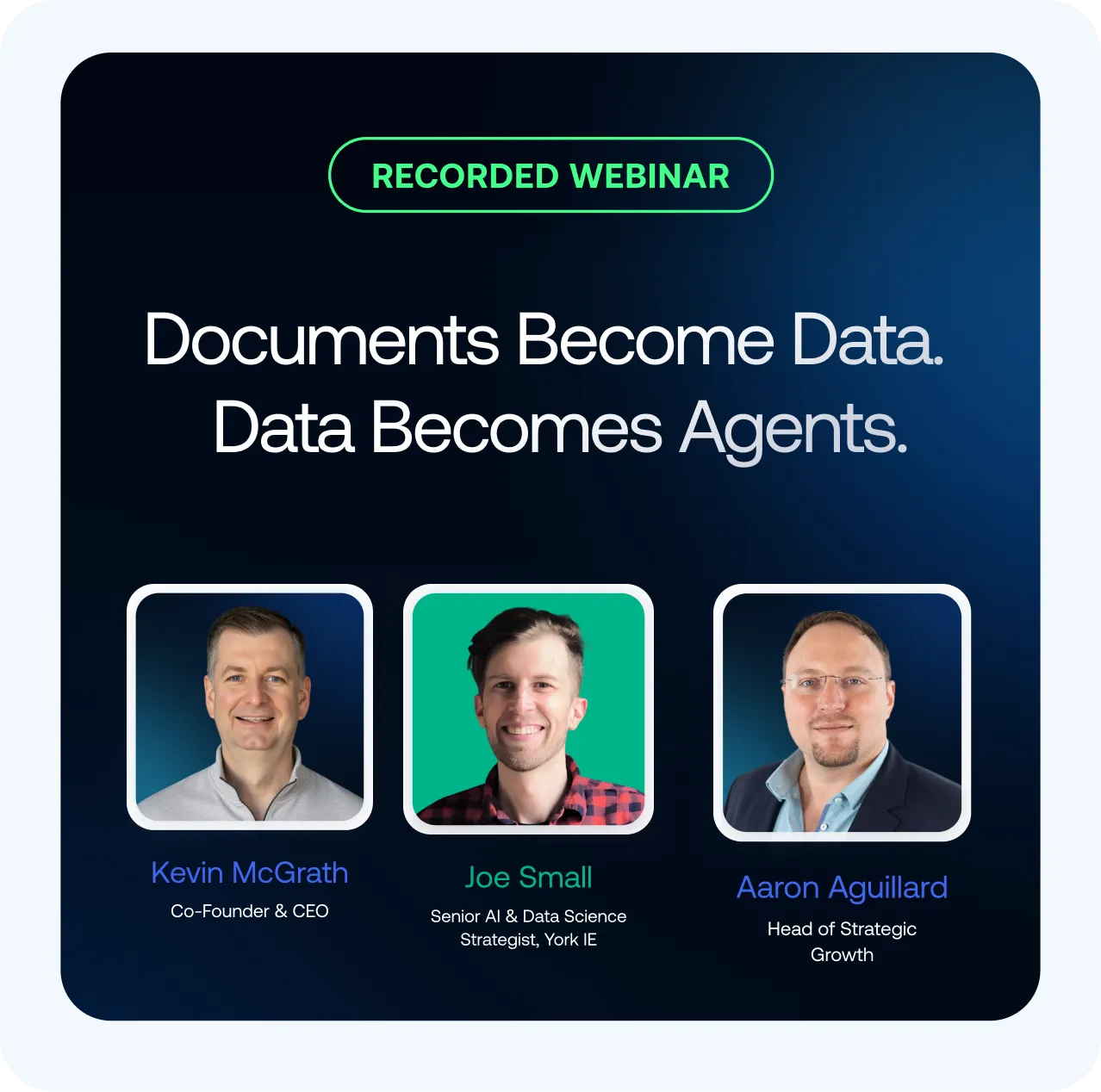
In our free 45-minute webinar, Meibel shows real examples from the field on how documents become structured, traceable data, then how production AI agents use that data across real workflows.



Every agent is defined by instructions, data sources, tools, model, and output schema. Changes happen in draft; publishing freezes the whole configuration. Same version, same input, same result. A bad version is reverted, not debugged.
An execution policy decides what a session can reach: which tables, documents, columns, and tools with which arguments. Enforced by the platform before the model call, not by instructions in a prompt. Fail-closed.
12 evals run on every agent output from a library of 15 modules with a written explanation; statistical modules compute 0.0 to 1.0 from the data. Never averaged. Scores drive routing: automate when confidence is high, flag, escalate, or block when it is low.
Set thresholds so low-confidence outputs are flagged, escalated, or blocked while routine work flows through. Review happens with the document on one side and the structured output on the other: click a value and the source pane jumps to that page.
Attach MCP tools, web search, custom APIs, and external agents without custom adapters. A2A lets your existing agents call Meibel agents and Meibel agents call yours. Your agent's capabilities grow with every tool you connect.
The configuration you developed and tuned on one document runs unchanged across the entire set. A batch definition pins that configuration as a snapshot so the two cannot drift. Results are written to an output datasource.

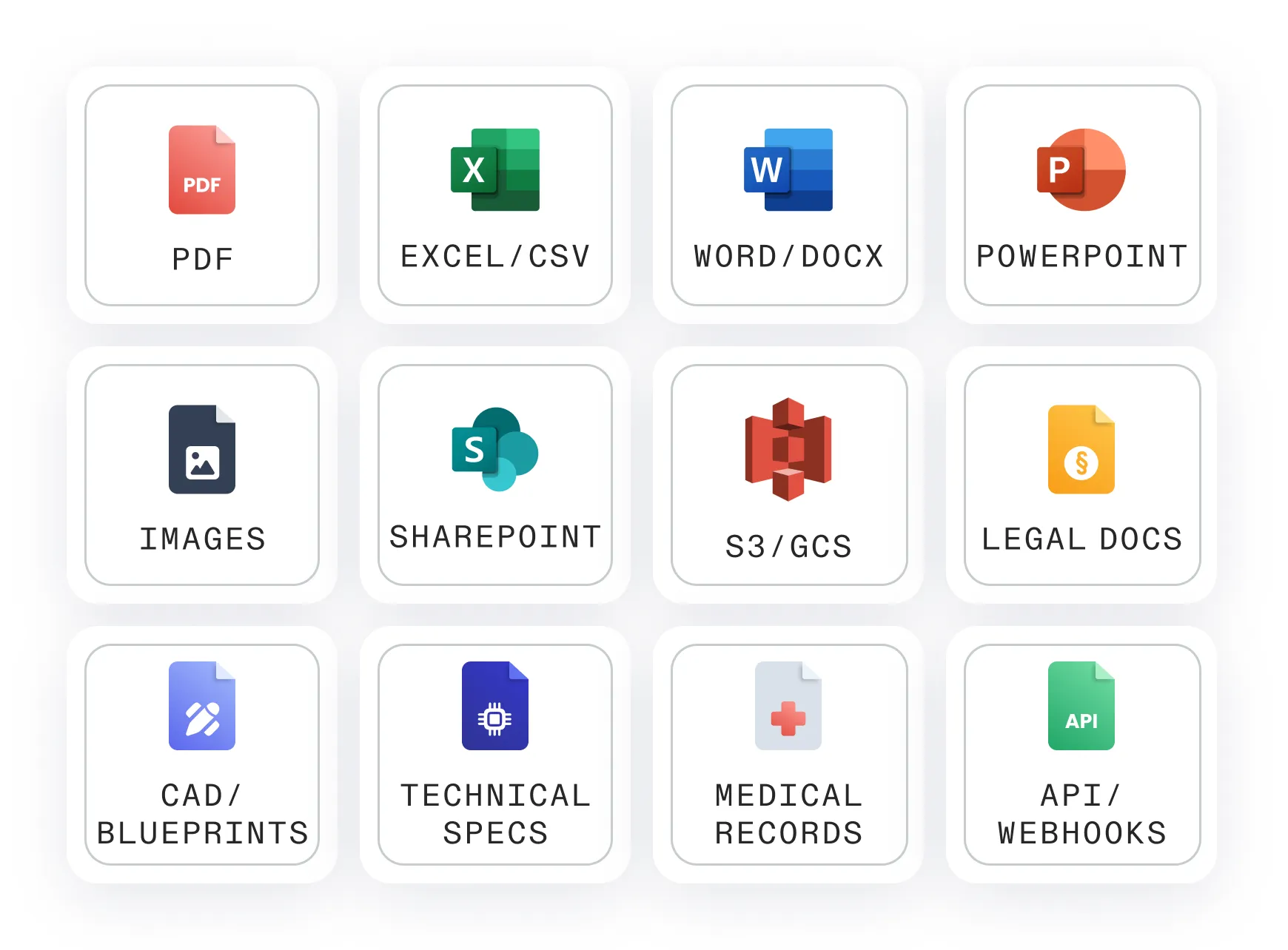
WHAT AGENTS CONNECT TO
Define your agent
Write instructions. Choose a model. Connect data sources. Attach tools. Define the output schema. Enable the scoring modules that matter. Set the confidence thresholds that decide what is flagged, escalated, or blocked
Connect your data
Bring in documents through Document Intelligence, structured data through connectors, or external systems through MCP tools. Your agent can use one source or combine them. Metadata indexed on a datasource becomes the dimension an execution policy filters on, so scoping access per customer or department happens here rather than in your own code.
Test interactively
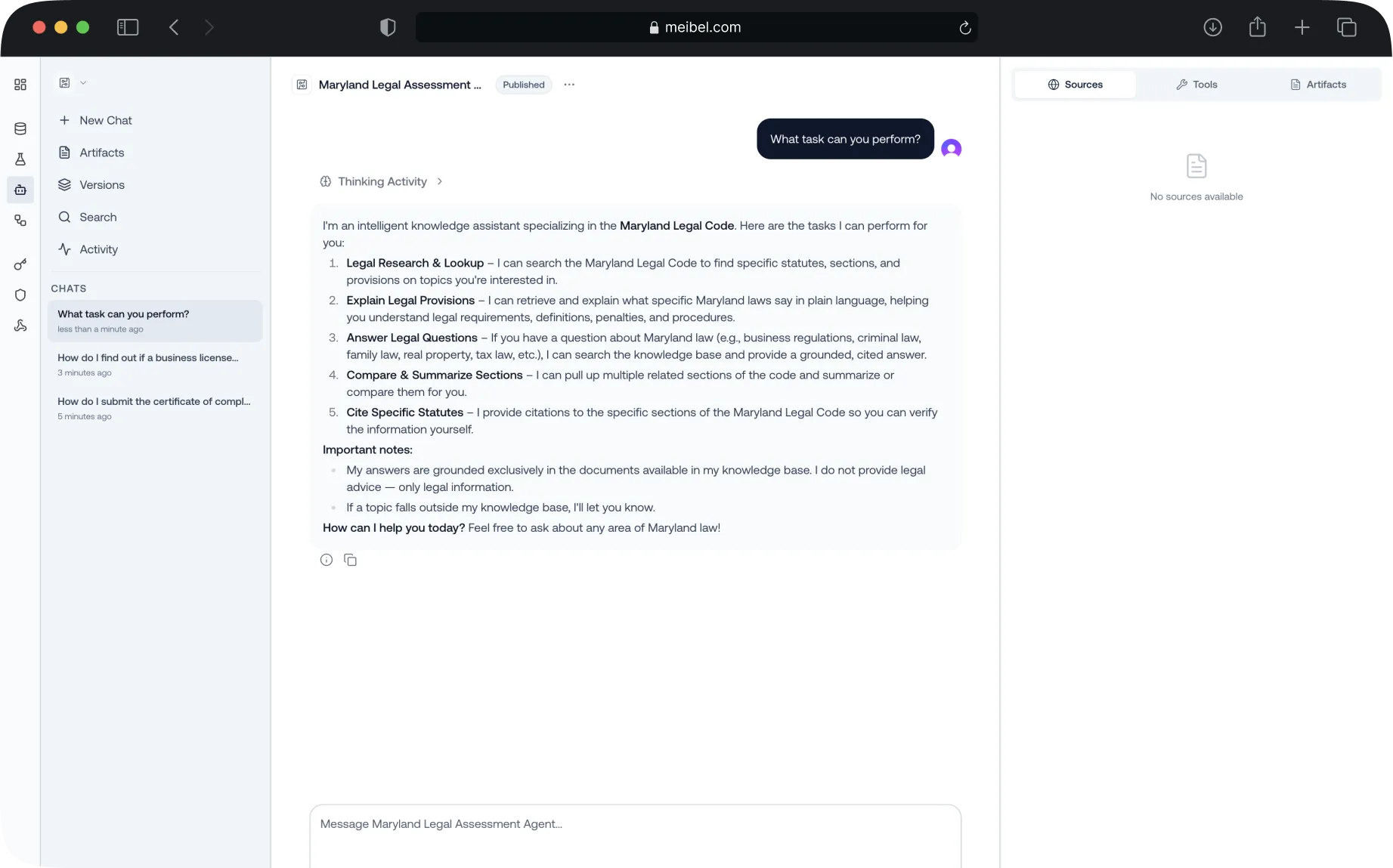
Run the agent in conversation mode. See every reasoning step, every tool call, every source retrieved. Refine instructions, adjust the schema, swap models. Iterate until the output is right.
Deploy as an API
Every agent is available as an API endpoint. Integrate into your application, your workflow, or your existing systems. Webhooks notify you when processing completes.
Scale to batch
The same agent runs on one item or a million, with the configuration pinned so it cannot drift between the two. Inputs come from a datasource and each result is written to an output datasource. Transient failures retry automatically; anything still failing is rerun in a targeted execution.
Monitor and improve
Confidence scores give you a consistent measurement across runs, so a change to a prompt, a schema, or a model can be evaluated rather than guessed at. Publish a new version, compare against the previous one, revert if it is worse.
Model-Agnostic and Deployment-Flexible. Use any major LLM with fallback support, switched per agent. Deploy as SaaS, BYOC, or on-premises. LLM costs passed through at cost with no markup; bring your own cloud agreements for negotiated rates.
Enterprise Security with Enforcement at Every Layer. SSO, SCIM, and role-based access control for identity. Execution policies constrain what each session can reach: which tables, documents, columns, and tools, enforced before the model call, not by prompt instructions. SOC 2 Type II on every tier.
Open Standards for Interoperability. A2A lets your existing agents call Meibel agents and Meibel agents call yours. MCP connects to external tools without custom adapters. AG-UI connects to compatible frontends. Your AI investments compose instead of competing.



WHAT ENTERPRISE AI TEAMS BUILD WITH MEIBEL








Try Meibel
Upload a real document, the messy kind. Get back structured data. Then build an agent on it and run the same thing at whatever volume you have.

An agent is an AI unit of work defined by instructions, tools, data sources, and an output schema. Once configured, the same agent runs identically every time. Agents reason over documents, query structured data, call external tools, and produce scored, traceable outputs. Changes stay in draft until you publish. Published versions are immutable: the same version number always produces the same behavior given the same inputs.
No. Agents work with any combination of documents, structured data, and external tools. Document Intelligence makes agents more powerful by providing deeper, scored, connected context from your private documents. But an agent can start with a CSV, a database connection, or an MCP tool. DI is the superpower, not the prerequisite.
Through MCP (Model Context Protocol) for tools and data sources, A2A (Agent-to-Agent) for interoperability with agents on other platforms, and API endpoints for integration into your applications. Secrets management handles authentication for external services.
Yes. Meibel is model-agnostic. Use any major LLM, with fallback model support so a secondary model takes over if the primary is unavailable. LLM costs are passed through at cost with no markup. You can also use your own cloud provider agreements at your negotiated rates.
Meibel runs 12 evals on agent outputs from a library of 15 scoring modules. Judged modules use an internal evaluator, score 0 to 10, and return a written explanation. Statistical modules compute a value from 0.0 to 1.0 from the data itself. You enable the modules that matter on the agent definition. Nothing is averaged. Scoring runs outside the execution path, so it does not slow the response. High-confidence results move forward; low-confidence results are flagged, escalated, or blocked.
Agents produce structured artifacts in JSON, CSV, or Markdown. You define the schema. The agent produces output that matches it every time. Results are downloadable, queryable, and available through the API.
Orchestration frameworks give you components to assemble yourself. To match what Meibel provides, a team assembles a parser, a vector database, a workflow engine, a tool router, an observability system, and a custom evaluation framework, then maintains all six. The per-run rate on open-source frameworks may look lower, but the total cost of building and maintaining the full stack favors Meibel. And no assembled stack replicates an integrated data and execution layer.
Minutes to define and test interactively. Days to refine for production quality. The same agent that works on one document scales to batch processing without code changes.
Usage-based pricing scaled to your volume. LLM costs are passed through at cost with no markup. Free entry-level tier available. Contact us for volume pricing.
.webp)