How Tetheree Built a Federal Bidding System That Multiplies Proposal Volume Without Adding Headcount




Tetheree's domains span supply chain, logistics, warehousing, manufacturing, and media. Increasingly, the firm has focused on the construction sector and government-related workflows, building solutions that connect standard enterprise software with the specialized processes their end customers depend on.
For twenty years, Tetheree has designed and built bespoke software for business enterprises. The firm consults, designs, develops, and maintains systems that its customers use to run their operations, from custom ERP modules to field reporting pipelines to AI-backed SaaS products. In Brian Sampson's words, "We're efficiency consultants, but we deliver product."
One of those customers, a construction company that bids on federal contracts, faced a critical bottleneck: their bidding process was entirely manual, with each RFP taking weeks of technical writing. To help their client scale, Tetheree set out to turn that expertise into a repeatable system.
Increase bid volume without adding a single new head to the team.

Expertise at its Limit
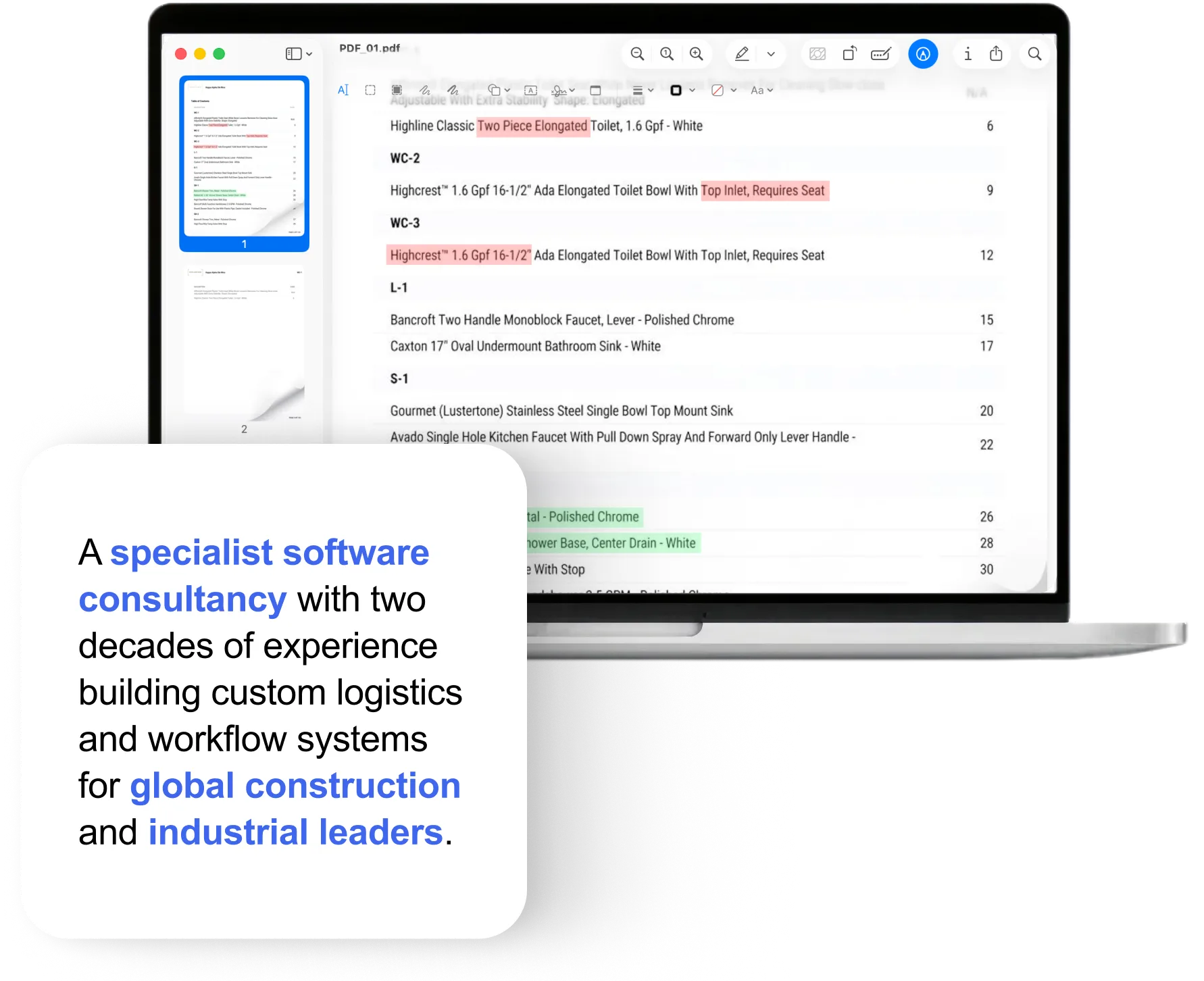
Tetheree's client had elite technical writers buried in 300-page federal documents. Critical scope information was buried hundreds of pages into each document, and proposal authors spent days doing syntax-based searches through SharePoint archives, copying and pasting language from prior responses, and manually extracting dates, requirements, and deliverables.
The writers were trading strategy for data entry. The constraint was not talent. It was the process consuming that talent.
Federal compliance demands more than text generation. It demands structured retrieval that can pull the right context from hundreds of pages. It demands precise queries against extracted data, where a database produces the numbers rather than a language model guessing at them. It demands traceability that links every output back to its exact source location in the original document. And it demands confidence scoring that measures output quality across multiple independent dimensions, not a single accuracy number.
These are infrastructure problems, not application problems. Tetheree recognized the difference. Rather than divert engineering time away from the domain logic and user experience where the firm excels, Tetheree looked for a platform partner purpose-built for structured AI execution.
The Platform Decision
That is where Meibel came in.
Tetheree chose Meibel as the infrastructure layer beneath their client-facing applications. Where earlier approaches required stitching together separate API calls, manual validation steps, and custom retrieval logic, Meibel provided these as integrated platform capabilities, accessible through the same APIs and SDK that Tetheree's engineering team already preferred to work with.
In early proof-of-concept work, Tetheree and Meibel outlined two capabilities for the construction industry:
The RFP Accelerator
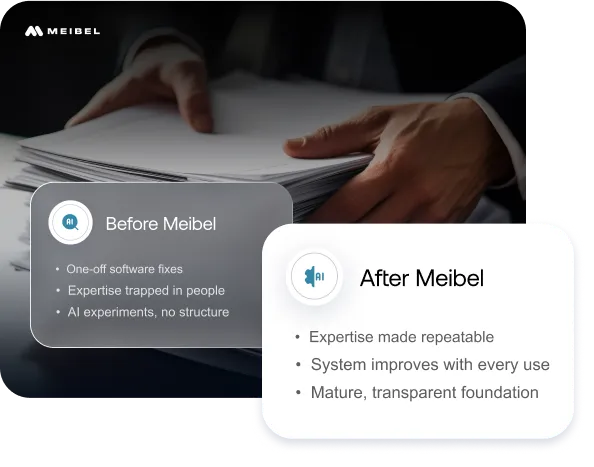
Ingests unstructured federal documents and applies Document Intelligence to understand their full structure: layout, reading order, tables, cross-references between sections. Key dates, deliverables, and requirements are extracted into structured, queryable form. Semantic search replaces the client's previous SharePoint syntax searches, allowing proposal authors to query their document corpus by meaning and retrieve copy-ready language and references in seconds rather than days.The Proposal Evaluator
Reviews draft responses against the original RFP using an agent workflow that checks for omissions, inconsistencies, and compliance gaps before submission. Each evaluation is scored across multiple quality dimensions, including completeness (were all required sections addressed?), faithfulness (is the response grounded in the source material?), and correctness (do referenced values match the original document?). Sections that fall below confidence thresholds are flagged for technical writer review rather than submitted with uncertain content.
Both capabilities run through Meibel's API, giving Tetheree full control over the user experience and application logic they deliver to their client.
.webp)

How It Works
Semantic search finds the passages most relevant to a given question by meaning, not just keyword match
Precise queries against structured data extracted from documents produce exact numbers, dates, and requirements. The database does the math, not the language model
Source traceability links every extracted value back to its exact location in the original document, down to the page and region, so reviewers can verify any output in context
When requirements are complex or confidence scores fall below defined thresholds on high-stakes sections, the system routes those sections to a technical writer for review. This is not a manual override. It is programmatic routing built into the workflow, with field-level importance levels determining which extractions require human sign-off and which flow through automatically.
This approach automates the daily analysis while preserving expert oversight where it matters most.
Measurable Outcomes
By moving from manual extraction to a structured AI system built on Meibel, Tetheree's client has begun transforming their federal bidding process:
Proposal throughput increased. Complex federal documents that once took weeks to review are now synthesized in days, allowing the team to pursue more bids without adding headcount
Response accuracy is verified automatically. Cross-referencing and multi-dimensional confidence scoring catch omissions and inconsistencies before submission, not after
Technical writers focus on strategy. With extraction, retrieval, and compliance checking handled by the system, writers spend their time on narrative quality and competitive positioning rather than data entry
Every output is traceable. Reviewers can click any extracted value and see exactly where it came from in the source document. In a federal compliance context, this provenance chain is not optional
The foundation is production-grade. Versioned workflows, checkpoint-based recovery, and confidence-scored outputs replace the fragile, manual validation steps of the prior process
Tetheree is also applying the same platform to a second use case: capturing field media (video, audio, and imagery gathered during site inspections) and synthesizing it into structured field reports. Information that was previously disposable, gathered on phones and never formalized, now flows through an automated process into structured data that drives downstream project workflows.
.webp)

A Deployment Model for Compliance
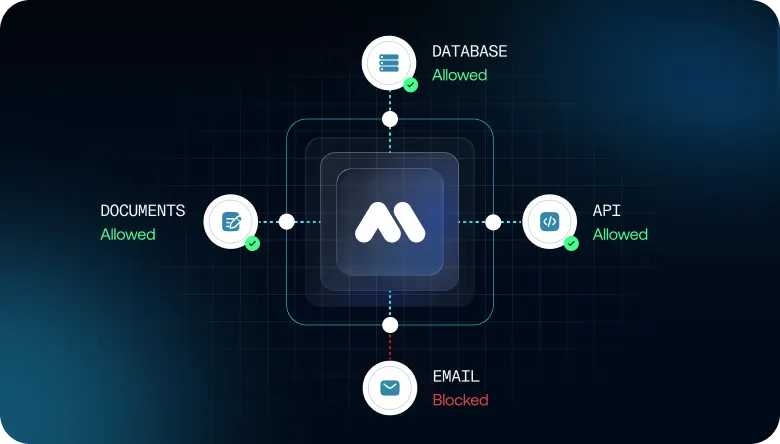
Federal work introduces data sensitivity requirements that most AI platforms cannot accommodate. Tetheree's client handles documents that may include Controlled Unclassified Information (CUI), which limits where data can be processed and stored.
Meibel supports multiple deployment models, including bring-your-own-cloud deployments in Azure (and Azure Gov for CUI/DoD sensitivities) as well as on-premises installation for maximum data sovereignty. For Tetheree, the availability of Azure Gov as an option simplifies compliance conversations with their client's executive team and removes a blocker that would have ruled out most AI platforms.
A Model for Partner-Delivered AI
This engagement illustrates a broader pattern. Tetheree is not a one-off customer. It is a services partner building repeatable AI capabilities on Meibel's platform and delivering them to its own clients.
The model works because the roles are clear. Meibel provides the document intelligence, retrieval infrastructure, confidence scoring, and execution controls. The partnership gives Tetheree's engineering team a production-ready infrastructure layer so they can focus entirely on the application logic, user experience, and client workflows where they add unique value.
For services firms, consultancies, and system integrators evaluating how to deliver AI solutions without rebuilding infrastructure for every engagement, this is the pattern: one platform, many customers, with the domain logic and data separated cleanly from the execution layer.
“There's a maturity to the platform and the underlying system, and also a domain knowledge that's specific to this area that the Meibel team brings to the partnership. It means my team gets to stay focused on what they're best at, building product for our clients, instead of rebuilding and maintaining infrastructure on their own.”
Try Meibel
Take Control of Your AI
Empowering engineering and product teams of any size to quickly build, run and scale Explainable AI Experiences.




.webp)

REQUEST A DEMO
Start Building AI You Can Measure & Trust
Bring transparency, traceability, and proof to every model,
at runtime.