contextual.ai alternative

Meet Meibel: The Platform That Thinks Across Your Documents.

Most RAG platforms optimize how your documents get searched. Meibel optimizes what gets searched: a cross-referenced, confidence-scored corpus with agents built natively on top.
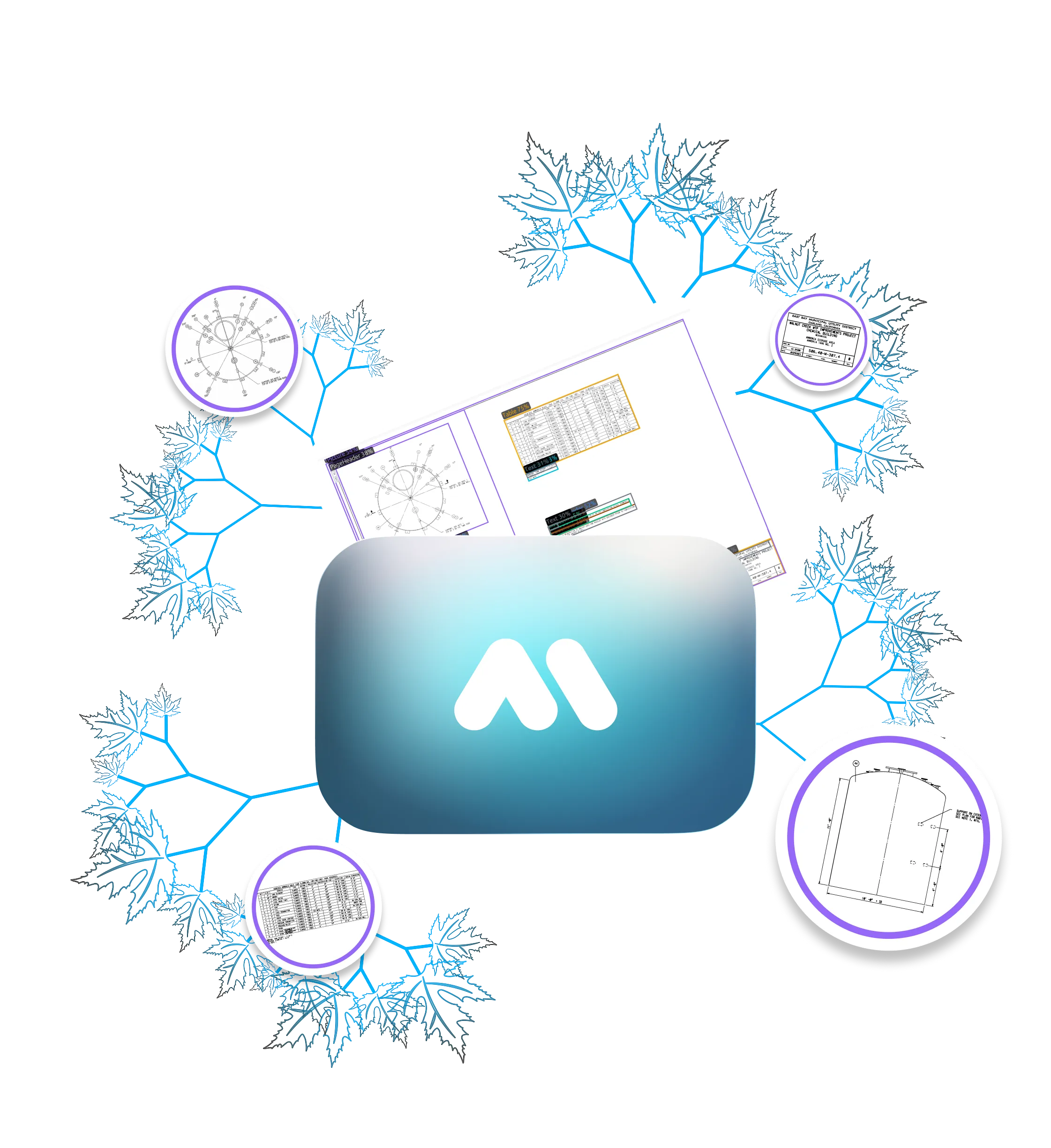

Trusted by:

Meibel vs CONTEXTUAL.AI

Why Stop at Retrieval if You Can Build Agents on Top of Your Whole Corpus?

Contextual.ai

An enterprise RAG platform built around RAG 2.0: a jointly optimized retriever and generator designed for accuracy on complex knowledge tasks. Built by the researchers who pioneered RAG at Meta FAIR, it powers specialized agents for expert knowledge work across financial services, technology, and technical industries.

Meibel Logo

Meibel

An AI orchestration platform built around Document Intelligence: a single system for parsing, cross-document understanding, confidence scoring, and agent deployment, so engineering teams can go from raw documents to a governed, production-ready agent without assembling separate tools for retrieval, scoring, and execution.

Why Production AI Teams choose Meibel

From raw documents to deployed agents, without assembling the stack in between.

  • One platform, no Elastic dependency

    Contextual AI's retrieval infrastructure runs on Elastic. Meibel's retrieval runs natively on the same platform as ingestion, confidence scoring, and agent execution. No external vector database to provision, tune, or maintain.

  • Agents that reason across documents
    Retrieval shows you what's in your documents. Meibel lets you build agents that act. One corpus, any number of agents on top: each one scoped to a use case, each one running on the same connected, scored document foundation.

  • Confidence on every output, not just at the source
    Contextual AI minimizes hallucination by training the model. Meibel scores every output across 14 dimensions. That's a trust layer built into the pipeline.
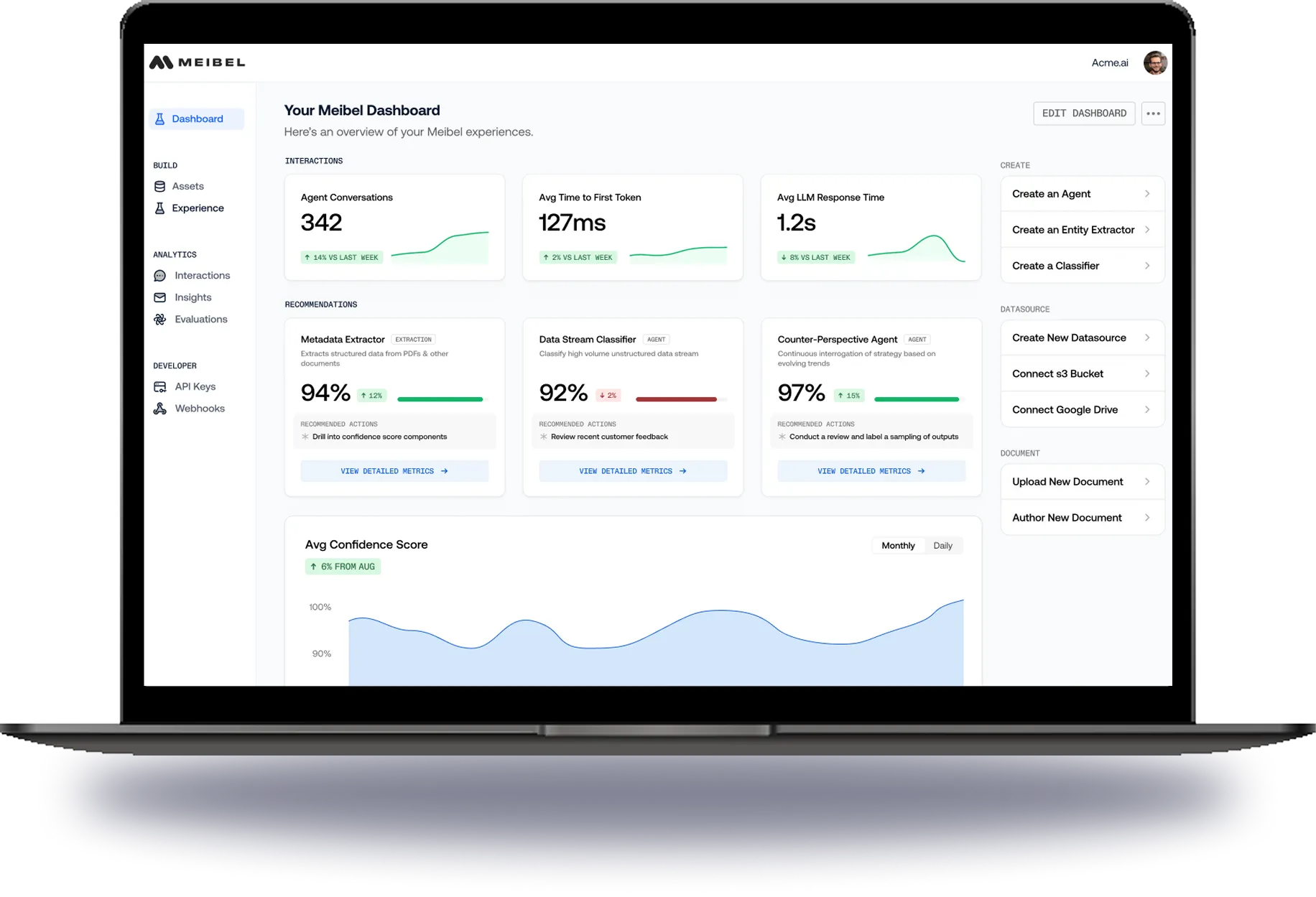
Why Production AI Teams choose Meibel

Data Ingest

Any Data Format. Enterprise Volumes.
No preprocessing

Point Meibel at your data. It handles classification, processing, and structuring. No pipeline to build, no schema to define, no infrastructure to manage.
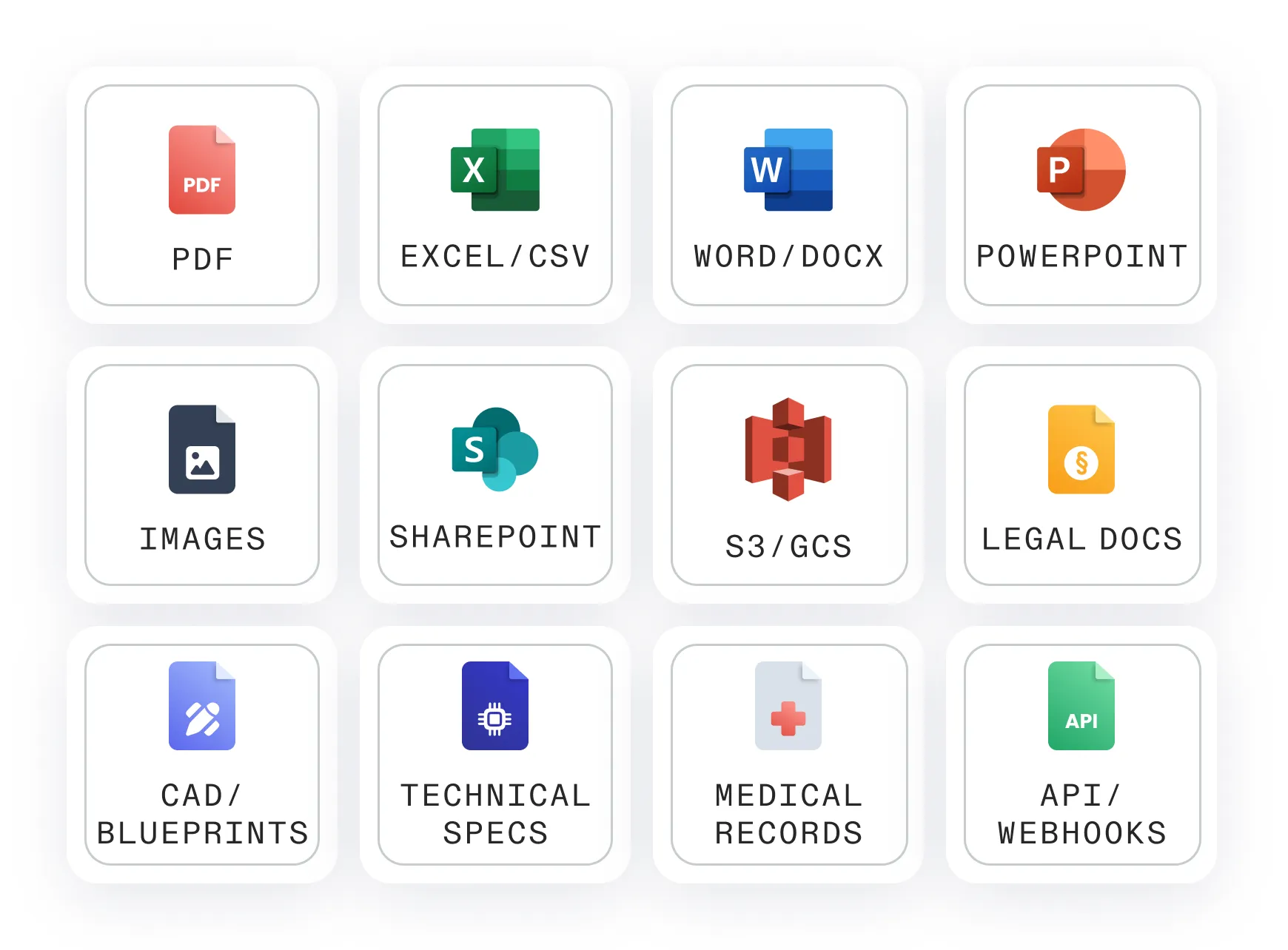
Meibel Dashboard

platform comparison

Compare Meibel and Contextual.ai on AI, Structure, and Production Readiness

This comparison is based on publicly available product documentation, and customer case studies from both companies as of July 2026. We update this page when products change.

Category
AI Orchestration Platform
Meibel
Document processing tool
Contextual.ai
RAG architecture
How retrieval and generation work together
Combined retrieval. Vector search, structured queries, and citation graph traversal run in a single step. Cross-document references followed automatically.
RAG 2.0. Retriever and generator jointly optimized for accuracy on complex knowledge tasks.
Cross-document reference graphs
Whether relationships between documents are tracked natively
Built automatically at ingest. Explicit and implicit references resolved into a traversable graph. Agents follow the full reference chain.
Contextual AI optimizes retrieval accuracy within the indexed corpus. Cross-doc relationship tracking is not described in public documentation.
Confidence scoring on outputs
How trust is applied to individual answers
Every output scored across coherence, completeness, correctness, faithfulness, relevance, and OCR confidence.
Grounding and source attribution built in. Per-output scoring across multiple dimensions not described in public documentation.
Vector database dependency
Whether external infrastructure is required
No external vector database to provision, tune, or maintain. Retrieval runs natively alongside ingestion, scoring, and agent execution.
Relies on Elastic for vector database and search infrastructure. Requires external dependency across cloud and on-premises deployments.
Document structure at ingest
What gets preserved before retrieval runs
Tables as structured data, document hierarchies built, cross-references resolved before a query runs. What goes into the index is connected knowledge, not isolated chunks.
Custom document understanding pipeline with multimodal support: tables, images, schematics, charts, and diagrams.
Try Meibel free on your documents

meibel’s Use Cases

Already Improving Outcomes for Teams Across Industries

One data corpus. Multiple experiences. Meibel lets you process your data once and build as many solutions as you need on top, without reprocessing or rebuilding your pipeline.
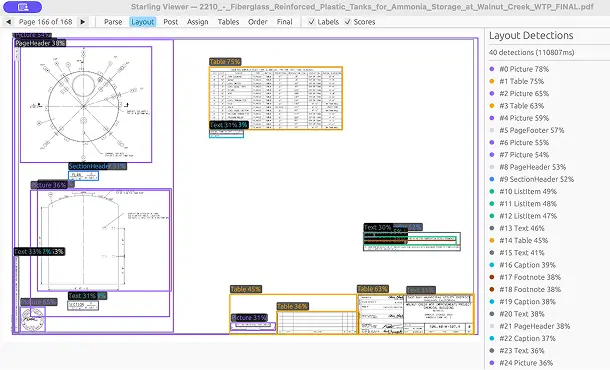

Manufacturing and industrial distribution

Product data sheets, COAs, OEM manuals, safety documents, and supplier records. Extract chemical characteristics where a single wrong digit creates legal liability. Consolidate supplier COA data across thousands of formats for trend analysis. Teams processing 30,000+ documents per month.

Construction and engineering

Specifications (1,600+ pages), RFPs, drawings, invoices, and inspection documents. Pull requirements from long technical documents and follow cross-references across the project corpus. Match spec requirements to SOPs and push structured data to project management systems. 100+ projects per year.

Financial services

Legal agreements (600+ pages), filings, covenants, triggers, and structured/unstructured financial data. Extract covenants that reference other covenants and triggers that reference transaction mechanisms. Combine precise queries with traceable document reasoning.

Legal, compliance, government, and healthcare

Regulations, filings, medical records, compliance frameworks, and personnel records. Translate regulatory documents into compliance policies. Cross-reference regulations with structured compliance data. Preserve provenance and control review paths for high-stakes outputs. Full audit trails for every extraction.

Insurance

Carrier statements, COIs, plan documents, and claims. Extract policy details, financial fields, and coverage metadata with confidence-gated review. Handle handwriting alongside typed text, stamps, and annotations. Teams scaling from hundreds to tens of thousands of users.
Trusted by:

try meibel

Try Meibel on Your Documents Free

Accurate retrieval starts with a connected corpus. See what Document Intelligence produces on your documents before you commit to a retrieval architecture.

Frequently Asked Questions

Contextual AI vs Meibel: what's the core difference?

Contextual AI is built around retrieval accuracy: jointly optimizing how the retriever surfaces passages and how the generator responds to them. Meibel is built around what feeds that retrieval step: the document structure, the cross-document citation graph, and the confidence score on the output. Teams that want better accuracy on a corpus they've already indexed and teams that want to change what the index contains are solving different problems.

Both platforms claim to reduce hallucinations. What's the actual difference?

Contextual AI reduces hallucination at the generation layer through a purpose-trained Grounded Language Model that's optimized for faithfulness. Meibel reduces it upstream: cross-document references are resolved before retrieval runs, and every output is scored across six dimensions before it reaches production. One approach improves how the model generates. The other changes what the model has access to and flags the result before it leaves the system.

Does Meibel require a vector database the way Contextual AI uses Elastic?

No. Document Intelligence handles structured and unstructured retrieval natively. There is no external vector database to provision, tune, or maintain.

How does Meibel handle multi-step reasoning across documents?

That's the core of what Document Intelligence is built for. When a spec references a drawing that references a materials standard, Meibel traces that chain at the corpus level, not at query time. Agents built on Meibel execute across that graph natively. The reasoning follows the document relationships because those relationships were built into the corpus before any query ran.

What makes Meibel a stronger long-term platform investment than a RAG-focused tool?

One corpus, any number of agents on top. Meibel lets you process your documents once and build as many solutions as you need without reprocessing or rebuilding the pipeline for each use case. As the problem grows from one retrieval use case to multiple agents across the same document set, the platform scales with it. A retrieval layer optimized for one workflow doesn't.