Reducto.ai alternative

Meet Meibel: AI
That Understands
Your Documents

Meibel gives engineering and AI teams one orchestration platform for document understanding, retrieval, confidence scoring, and agent deployment.

Trusted by:

Meibel vs Reducto

Parsing Gets You Structured Data.
Document Intelligence Gets You Answers.

Reducto

An agentic document parsing API that turns messy PDFs, scans, and spreadsheets into accurate, LLM-ready structured data. Combines computer vision and vision-language models with a self-correcting OCR layer, and is used by teams like Harvey, Vanta, and Scale AI as a managed ingestion layer ahead of their own pipeline.

Meibel Logo

Meibel

An AI orchestration platform built around Document Intelligence: a single system for parsing, cross-document understanding, confidence scoring, and agent deployment, so engineering teams can go from raw documents to a governed, production-ready agent without assembling separate tools for retrieval, scoring, and execution.

Why Production AI Teams choose Meibel

Easy to integrate, easy to manage

  • Built past the parsing layer

    Reducto handles single-document accuracy well. Meibel starts where that ends: cross-document citation graphs, confidence scoring, and agents on the same corpus.

  • Confidence as infrastructure, not an afterthought
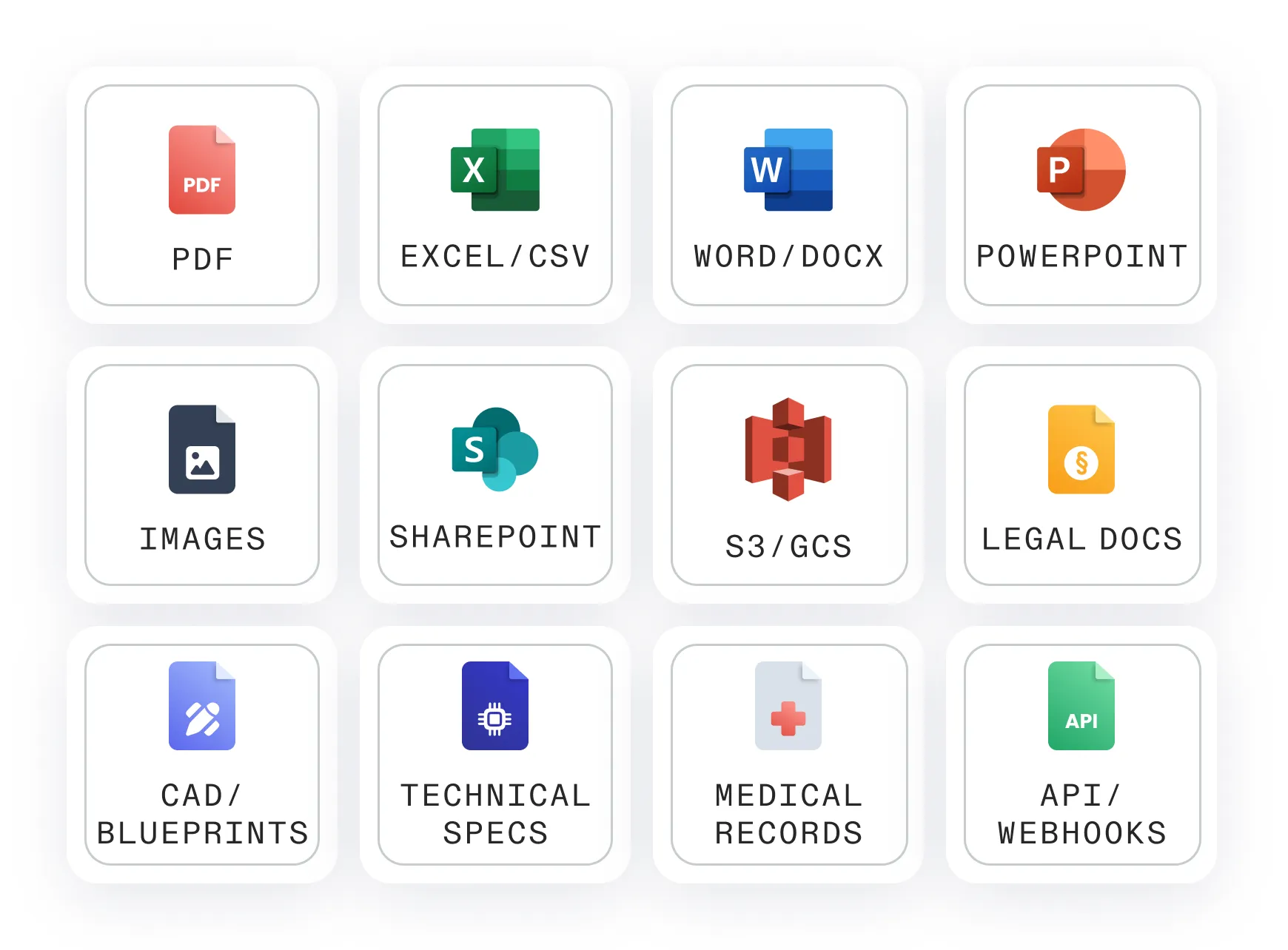
    Every output is scored across six dimensions and routed automatically. Most teams build this layer themselves on top of a parsing API.

  • One platform, not a stack of point tools

    Document Intelligence, retrieval, and agent orchestration run natively on Meibel. No separate vector database, no glue code between parsing and production.
Why Production AI Teams choose Meibel

Data Ingest

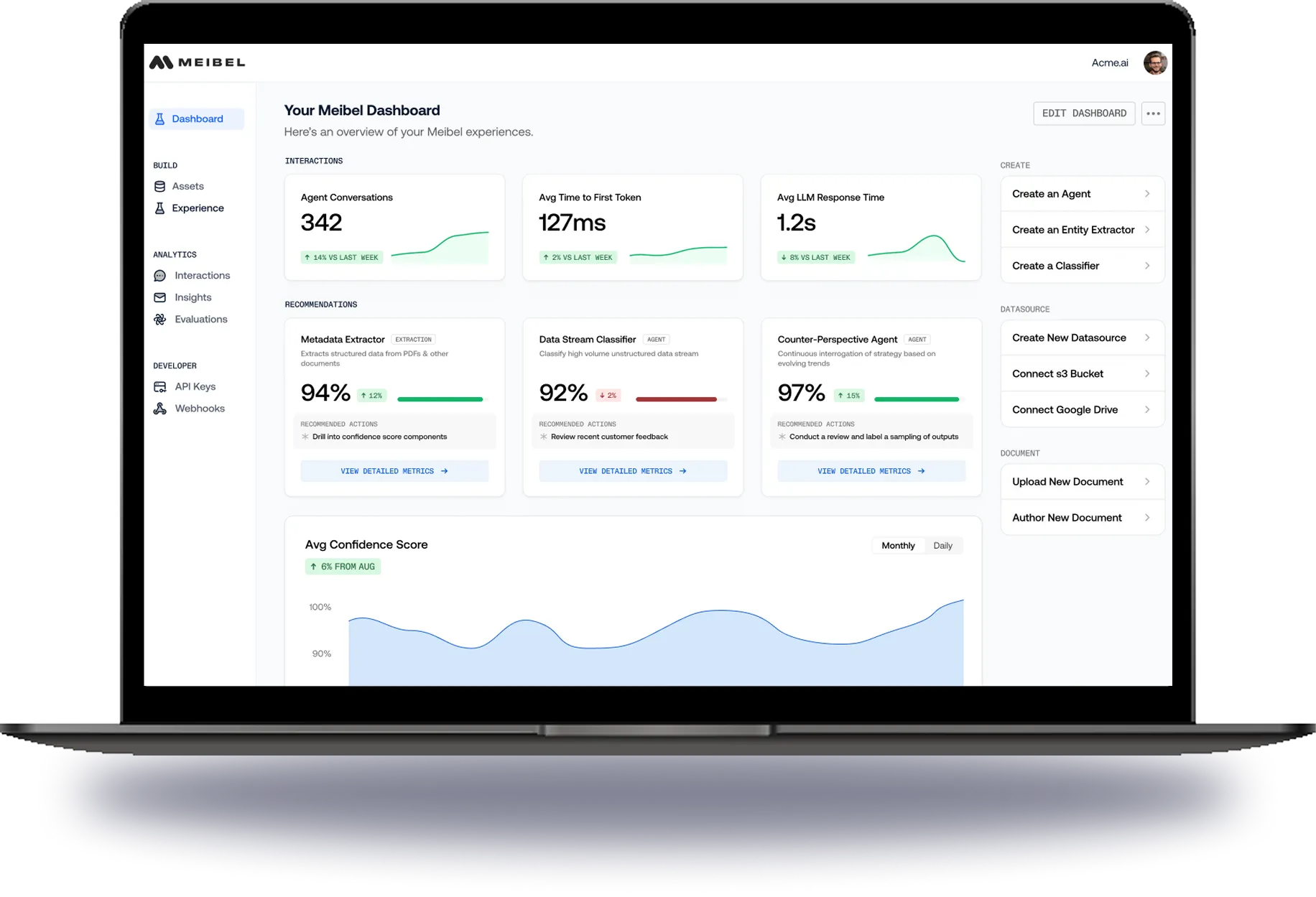
Any Data Format. Enterprise Volumes.
No preprocessing

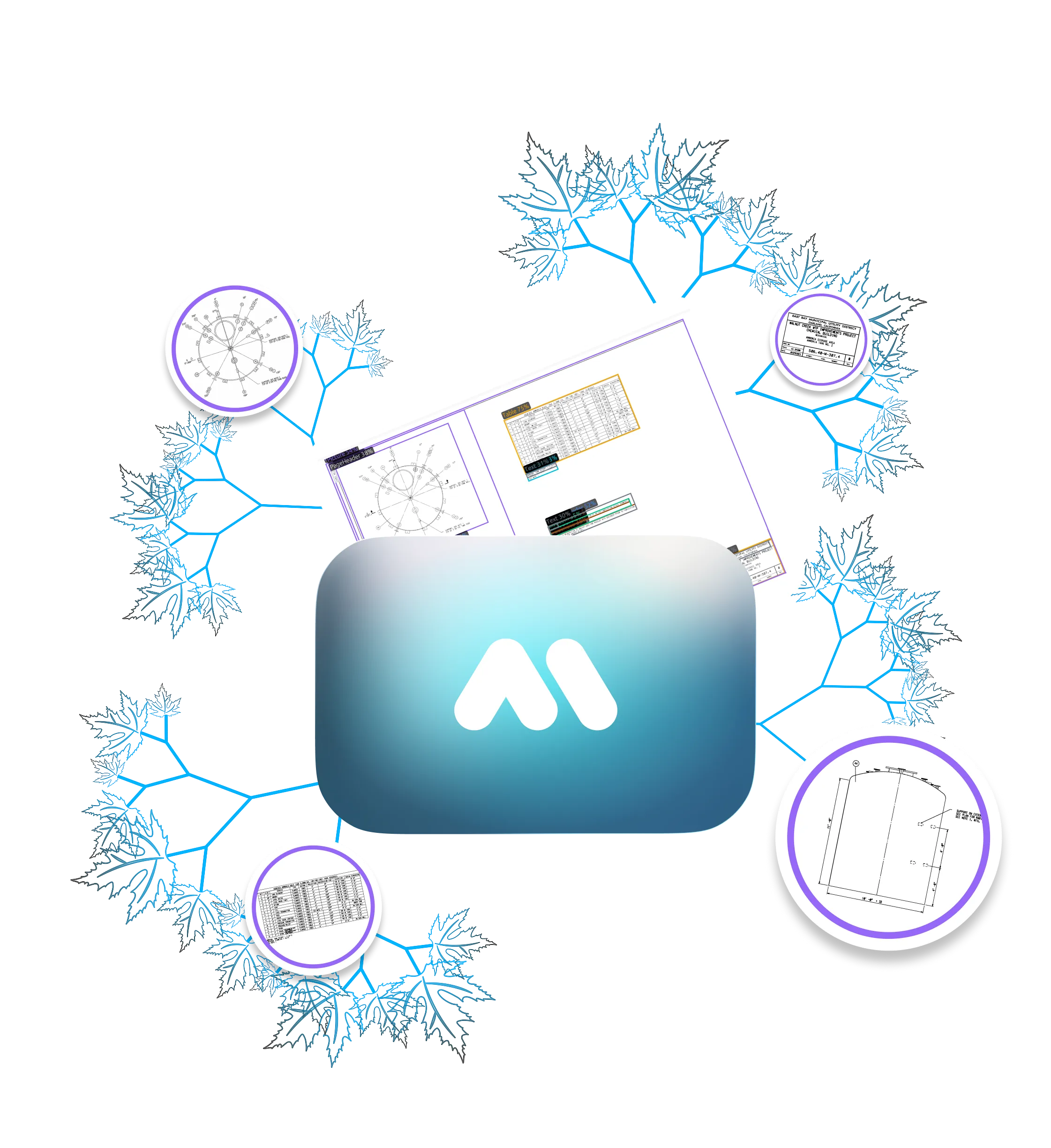
Point Meibel at your data. It handles classification, processing, and structuring. No pipeline to build, no schema to define, no infrastructure to manage.
Meibel Dashboard

platform comparison

Compare Meibel and Reducto on AI, Structure, and Production Readiness

This comparison is based on publicly available product documentation, and customer case studies from both companies as of July 2026. We update this page when products change.

Category
AI Orchestration Platform
Meibel
Document processing tool
Reducto
Document parsing & structure extraction
Any file, any complexity. Tables stay structured, handwriting gets read, mixed content handled automatically across 25+ formats.
Any file, any complexity. Strong layout detection, table extraction, and handwriting support via computer vision and vision-language models.
Native AI built into workflows
How deeply AI is embedded in the platform
Native and agentic. Confidence scoring, decision routing, and agent orchestration are built into the platform, not added on top.
Strong on parsing accuracy. Agentic OCR improves extraction quality. AI is not extended into downstream retrieval or agent workflows natively.
AI beyond extraction
What the platform does after a document is parsed
Retrieval, routing, and execution. The same corpus that feeds Document Intelligence feeds agents built and run on the same platform.
Schema extraction, splitting, and editing. Capable extraction layer. The agent and retrieval layer is built and maintained separately.
Published accuracy and scale proof
What outcomes are publicly documented
Outcome-level proof. 3 minutes to 7 seconds per document. Scaled from 110 to 30,000 users on the same platform without added headcount.
Volume and accuracy proof. 99%+ accuracy claim across 1B+ pages processed across customers including Harvey, Vanta, and Scale AI.
Cross-document reference graphs
Whether relationships between documents are tracked natively
Built automatically at ingest. Both explicit citations and implicit references resolved into a graph. Retrieval follows the full chain without manual wiring.
Not published. Documents are parsed independently. Cross-document relationships are not tracked natively in the published product.
Confidence scoring on outputs
Whether individual outputs carry a trust signal
Every output scored across 14 dimensions, integrated into execution.
Platform-level accuracy benchmarks are available. Per-output confidence scoring is not described in public product documentation.
Agent building and orchestration
Whether agents can be built on the same platform
Native agent runtime. Agents built directly on the same corpus. No separate orchestration layer, vector database, or glue code required.
Not available. No native agent runtime. Customers build and maintain their own orchestration layer on top of Reducto's parsed output.
Try Meibel free on your documents

meibel’s Use Cases

Already Improving Outcomes for Teams Across Industries

One data corpus. Multiple experiences. Meibel lets you process your data once and build as many solutions as you need on top, without reprocessing or rebuilding your pipeline.

Manufacturing and industrial distribution

Product data sheets, COAs, OEM manuals, safety documents, and supplier records. Extract chemical characteristics where a single wrong digit creates legal liability. Consolidate supplier COA data across thousands of formats for trend analysis. Teams processing 30,000+ documents per month.

Construction and engineering

Specifications (1,600+ pages), RFPs, drawings, invoices, and inspection documents. Pull requirements from long technical documents and follow cross-references across the project corpus. Match spec requirements to SOPs and push structured data to project management systems. 100+ projects per year.

Financial services

Legal agreements (600+ pages), filings, covenants, triggers, and structured/unstructured financial data. Extract covenants that reference other covenants and triggers that reference transaction mechanisms. Combine precise queries with traceable document reasoning.

Legal, compliance, government, and healthcare

Regulations, filings, medical records, compliance frameworks, and personnel records. Translate regulatory documents into compliance policies. Cross-reference regulations with structured compliance data. Preserve provenance and control review paths for high-stakes outputs. Full audit trails for every extraction.

Insurance

Carrier statements, COIs, plan documents, and claims. Extract policy details, financial fields, and coverage metadata with confidence-gated review. Handle handwriting alongside typed text, stamps, and annotations. Teams scaling from hundreds to tens of thousands of users.
Trusted by:

try meibel

Try Meibel on Your Documents Free

Before you commit to Reducto, explore Meibel
side-by-side with your use case.

Frequently Asked Questions

Is Meibel a replacement for Reducto, or does it work alongside it?

For most teams, a replacement. Document Intelligence includes its own parsing and extraction layer, so there's no need to run both. The difference is scope: Reducto stops at structured output per document. Meibel continues into cross-document understanding, confidence scoring, and agent execution on the same platform.

We already built a pipeline on top of Reducto. How much would we need to rebuild?

The parsing layer transfers cleanly. What Meibel replaces is everything your team built after parsing: the retrieval logic, the citation tracking, the confidence checks, the agent orchestration. Most teams find that's exactly the part they didn't want to own long-term.

Can Meibel handle the same document types and volumes Reducto does?

Document Intelligence processes PDFs, scans, spreadsheets, presentations, images, and more across 25+ formats. On volume: our client in insurance scaled from 110 to 30,000 users on the same platform. There is no published ingest limit on enterprise plans.

Reducto is API-first and fits cleanly into our existing stack. Is Meibel as flexible?

Meibel connects via API, SDK, or hosted UI and integrates with your existing LLM and infrastructure rather than replacing it. The difference is that the retrieval, confidence, and agent layers are available on the same platform if you want them, rather than requiring separate tooling.

How does Meibel compare on raw extraction quality?

Extraction accuracy is table stakes for both platforms. Where they diverge is what gets measured beyond accuracy: Meibel scores every output across six dimensions at the individual output level, not just as a platform-wide benchmark. That means low-confidence extractions get flagged before they reach production, not after.