Use case · Utility tariffs

Check every utility bill against the tariff.Here's how the agent is built.

A utility bill is a tariff applied to a meter read. This walkthrough builds an agent that prices any usage under every schedule a customer qualifies for, from the tariff's own rates, and cites the sheet. Every step is a real build in Meibel, on public tariffs from two state commissions.

Free to start. No credit card.

The goal

One customer, four schedules.A $16.79 spread in the same month.

To price a bill or pick a schedule, an analyst answers four questions. Each answer lives in a different part of the tariff.

Which schedules does the customer qualify for?Availability clauses rule some out: employees, congregations, retail-choice customers.Availability of Service
Which rate applies to each hour?Time-of-use periods and seasons, each with its own cents per kWh.Sheet 8-1
Which riders go on top?Each rider is its own line on the bill, with its own rate and sheet.Rider sheets
Which state and which revision?The same company prices energy flat in Virginia and tiered in West Virginia.VA Tariff No. 28 · WV Tariff No. 16

Today a bill gets checked when someone complains. The agent can price every one.

Data sources

Every tariff in one place.

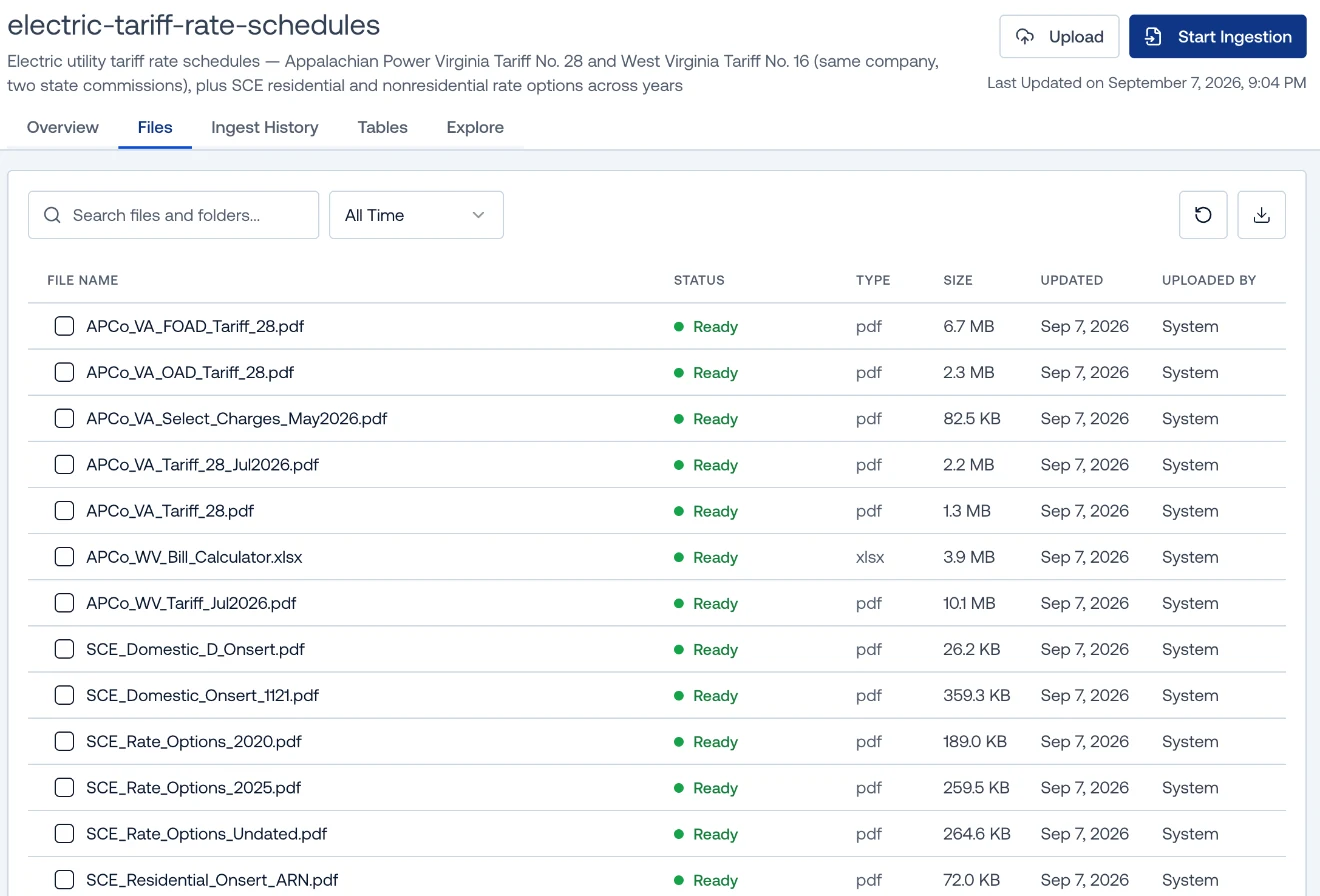
Fourteen public documents go into one data source: Appalachian Power's Virginia and West Virginia tariffs, including two revisions of Virginia Tariff No. 28, SCE rate options across years, and two utilities' own bill calculation workbooks.

  • Create a data source.
  • Upload the PDFs and spreadsheets.
  • Start ingestion.
Data sourcesIn the docs
The electric-tariff-rate-schedules data source in Meibel: Appalachian Power Virginia and West Virginia tariffs, a bill calculator workbook and SCE rate options, every file Ready.

Parse

Rate tables stay tables.

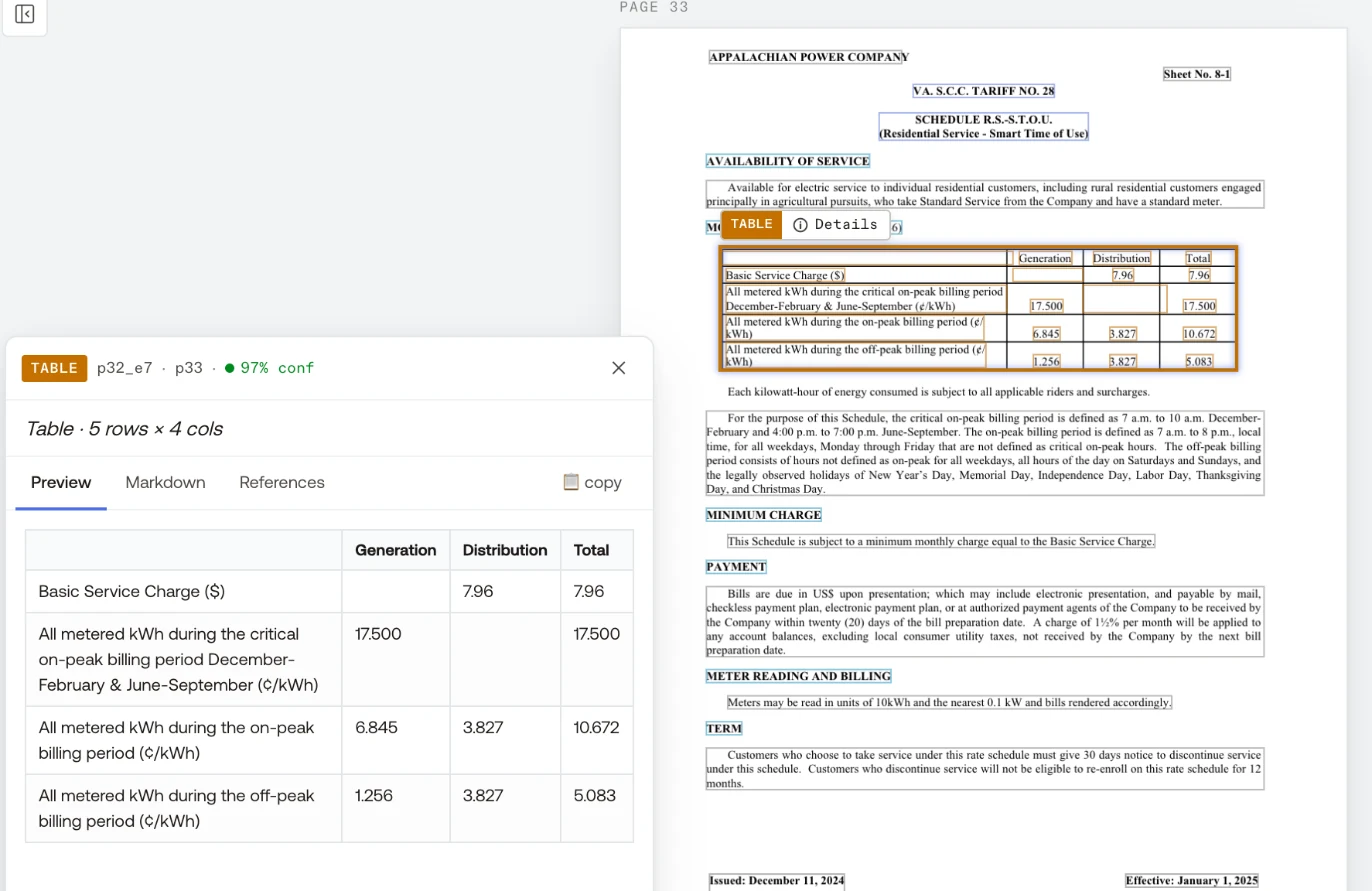
Ingestion parses every sheet. On Sheet 8-1, the Smart Time of Use rates come out as rows and columns: generation, distribution and total for each billing period, each cell in its place on the page.

  • Nothing to configure.
  • Open any sheet to see the parsed table beside the original.
Extracting tablesIn the docs
Sheet 8-1 of Appalachian Power's Virginia Tariff No. 28 in Meibel, with the Smart Time of Use rate table selected and read as 5 rows and 4 columns: basic service charge 7.96, critical on-peak 17.500, on-peak 10.672 and off-peak 5.083 cents per kWh.

Schema

One row per schedule, period, season and tier.

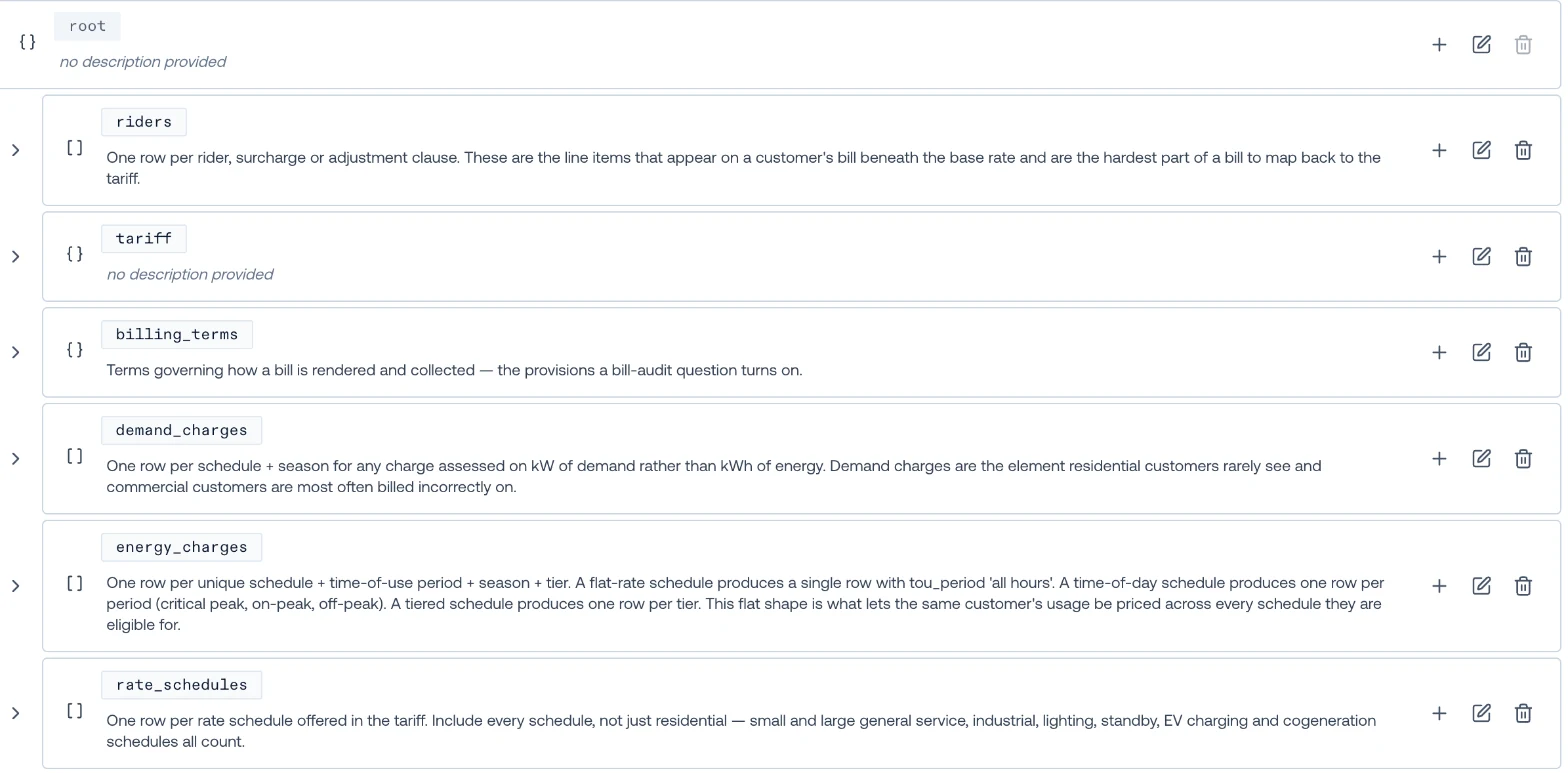
Every tariff becomes one record: the tariff itself, its rate schedules, energy charges, demand charges, riders and billing terms.

  • Say what one row means in each field description.
  • Keep every rate as a number with its unit.

TipA flat shape for energy charges is what lets one customer's usage be priced under every schedule they qualify for.

Prompts and schemasIn the docs
The Tariff Rate Schedule schema in Meibel with fields for riders, the tariff, billing terms, demand charges, energy charges and rate schedules, each with a description of what one row holds.

Extract

The extractor reads one document at a time.

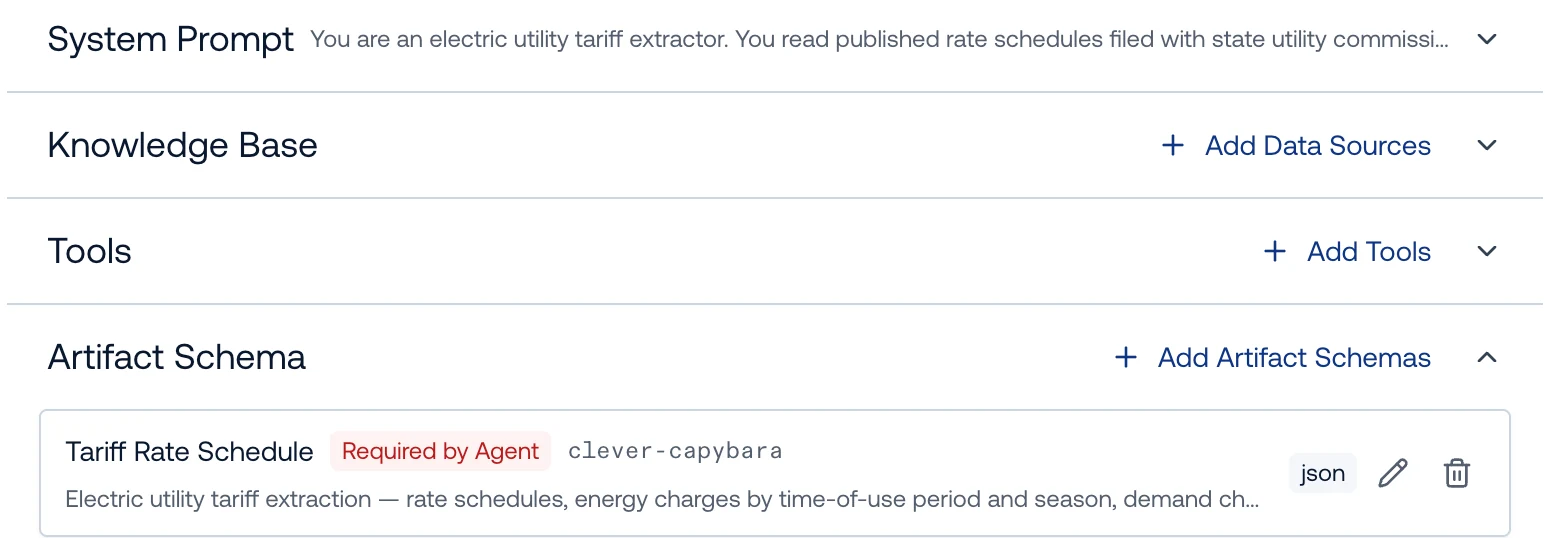
An extractor is an agent with the schema switched on as required and no data sources attached. It reads only the document it's given and returns one record.

  • Attach the schema and mark it required.
  • Leave the knowledge base empty.
AgentsIn the docs
The Tariff Extractor in the Meibel Agent Builder: an empty knowledge base and the Tariff Rate Schedule schema marked Required by Agent.

Batch

Run it on every tariff and workbook.

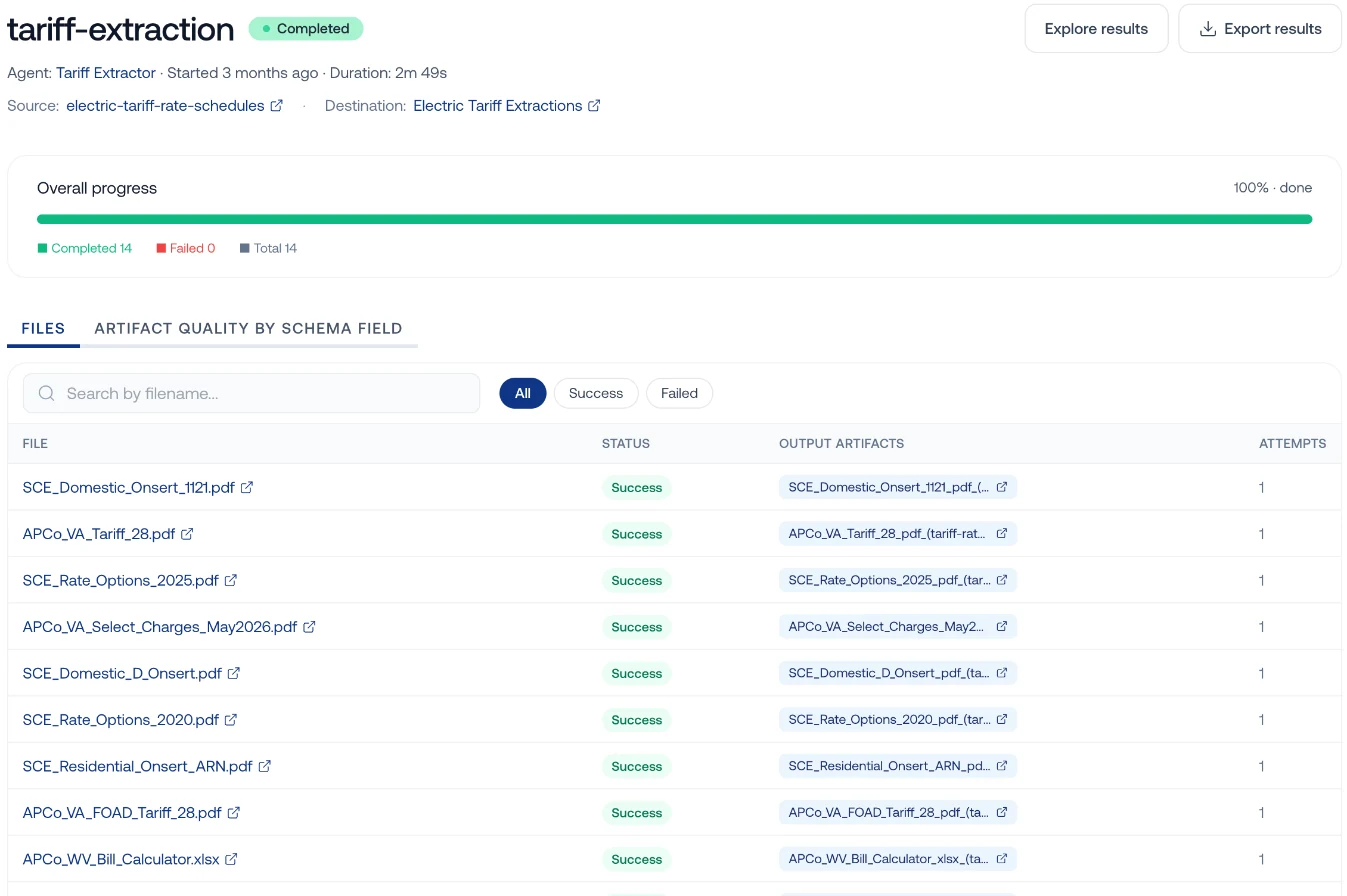
A batch runs the published extractor once per file, PDFs and spreadsheets alike, and writes every record into a new table. Here: 14 of 14 files, none failed.

  • Choose the extractor and the tariffs data source.
  • Let Meibel create the output table.
  • Open the results as a table.
Batch jobsIn the docs
The tariff-extraction batch in Meibel: completed, 14 of 14 files, from electric-tariff-rate-schedules into Electric Tariff Extractions, tariffs and a bill calculator workbook marked Success.

Multiple data sources

Give the analyst both.

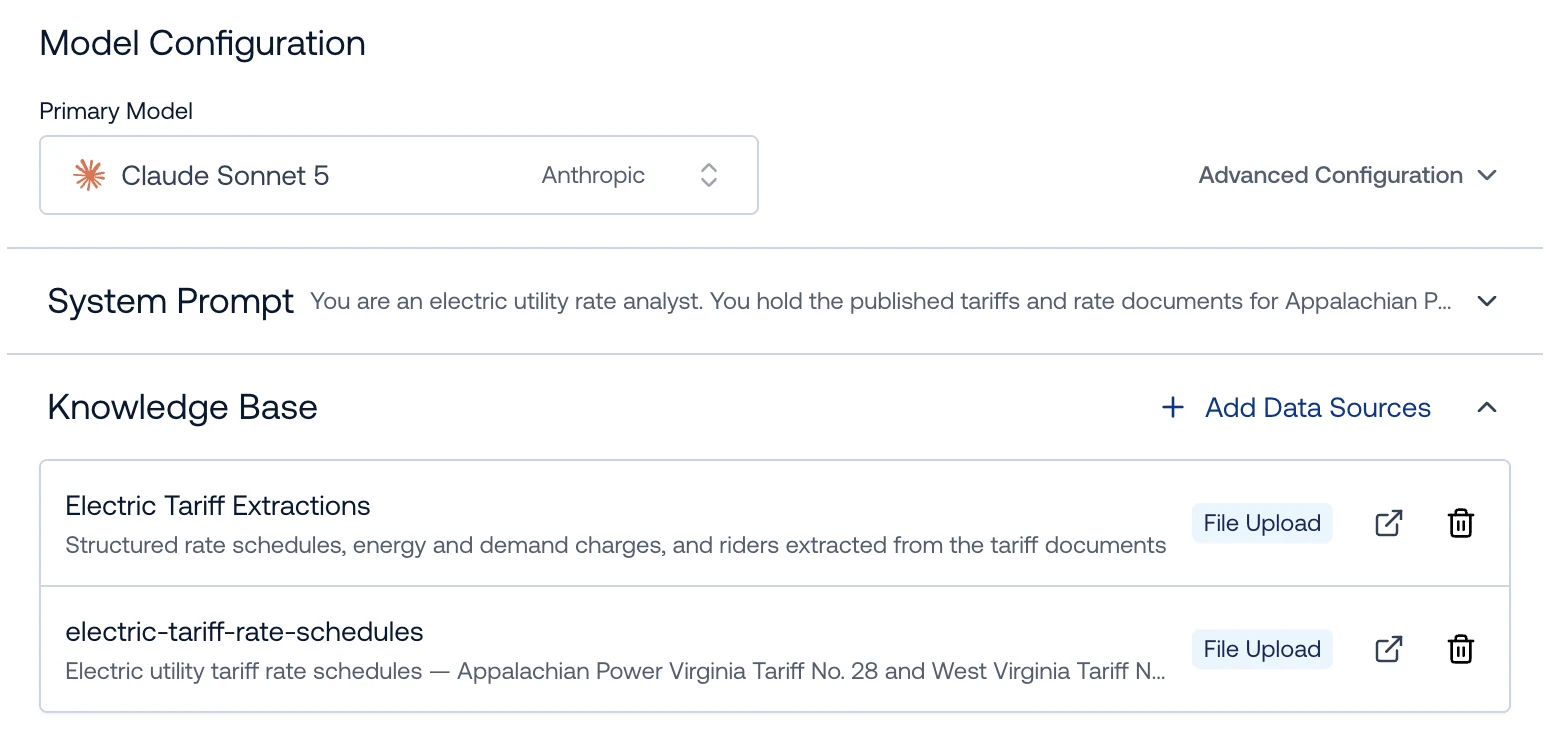
The documents answer what an availability clause says and on which sheet. The table answers what every rate is, in every schedule, state and revision. The agent searches one and queries the other.

  • Attach both in the knowledge base.
  • Describe each one so the agent knows which to use.
Building agentsIn the docs
The Utility Tariff Analyst in the Meibel Agent Builder: Claude Sonnet 5 with two data sources in its knowledge base, Electric Tariff Extractions and electric-tariff-rate-schedules.

Confidence scoring

Choose what every answer is scored on.

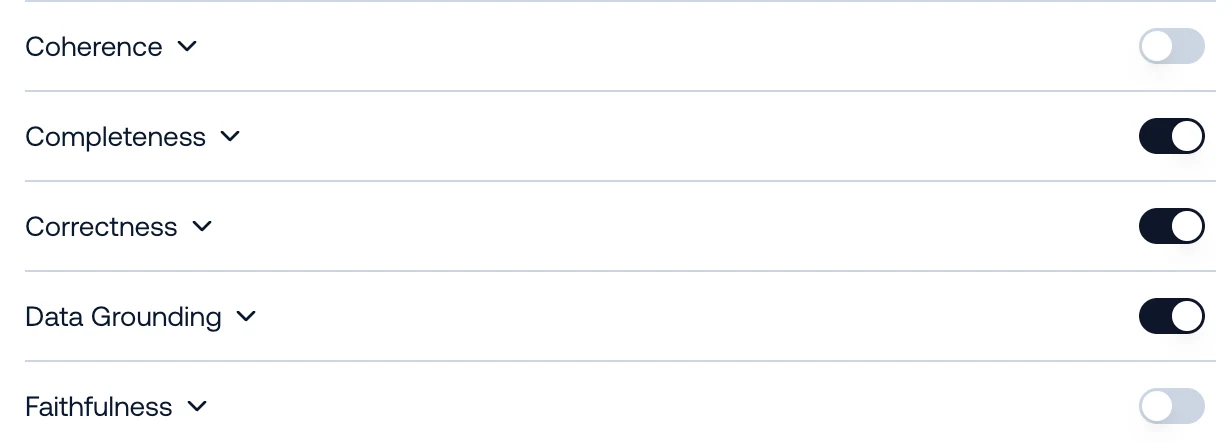
This agent is scored on completeness, correctness and grounding in its data. You choose the checks, and you decide what a low score triggers.

  • Switch on the checks that matter for a bill.
  • Read the scores on every answer in chat, the API or a batch.
Confidence scoringIn the docs
Evaluation checks in the Meibel Agent Builder with Completeness, Correctness and Data Grounding switched on.

Ask it

Same usage, four schedules.$75.56 to $92.35 a month.

One question to the Utility Tariff Analyst, priced from the tariff's own rates and cited to the sheet.

Utility Tariff AnalystVirginia S.C.C. Tariff No. 28

A residential Appalachian Power customer in Virginia uses 1,000 kWh a month, with 300 kWh on-peak and 700 off-peak, and a 5 kW peak demand. Price that usage under every Virginia residential schedule they are eligible for and tell me which one they should be on.

R.S.-S.T.O.U. is cheapest for this usage pattern: $75.56, narrowly ahead of R.S.-T.O.D. ($0.68 apart).

ScheduleHow it's pricedMonthly total
R.S.-S.T.O.U. Smart Time of Use (Sheet 8-1)$7.96 + 300 × 10.672¢ + 700 × 5.083¢$75.56 (cheapest)
R.S.-T.O.D. Time-of-Day (Sheet 7-1)$9.82 + 300 × 14.306¢ + 700 × 3.358¢$76.24
R.S. Traditional (Sheet 4-1)$7.96 + 1,000 × 7.622¢$84.18
R.S.-S.D. Smart Demand (Sheet 6-1)$7.96 + 300 × 7.028¢ + 700 × 3.358¢ + 5 kW × $7.96$92.35 in a demand-season month

Spread: $16.79, 22.2% between cheapest and most expensive

It answers the next questions the same way

What does the same company charge in West Virginia?A $14.02 basic service charge and tiered energy: 11.100¢ for the first 500 kWh, 9.584¢ after. Virginia is flat at 7.622¢.
Does the bill match the utility's own workbook?Yes: $210.94 for 1,200 kWh in October, both ways. It flags one rider the workbook may count twice, and shows the $214.42 total if it does.
Which riders go on top?Twelve Virginia riders, each with its rate and sheet. It keeps them out of the totals because the tariff doesn't fully state how the S.B.R.R. credit interacts with them.

Run it on every bill

Refine it on one bill.Run it on every account.

Publish the agent and point a batch at a month of bills, or call it as an MCP tool from your billing system. You decide what a low score sends to a person.

Make it yours

Swap in your utilities.Keep the steps.

Your documentsYour utilities' tariffs, rider sheets and rate notices.
Your recordAdd the fields your audit checks, such as minimum charges or late fees.
Your measureRun a month of bills you've already audited. Compare what it caught, what it missed and the cost per bill.

Try Meibel

Build the tariff analyst.Start with your own utilities.

Load a few tariffs, shape the record and price your first bill.

  • Rate tables parsed as tables.
  • One row per schedule, period and tier.
  • Two data sources, one agent.
  • Every answer scored and sourced.

Questions

What teams ask first.

Do I need the extraction step?

No. An agent can search the parsed tariffs directly. The table is what lets one usage profile be priced under every schedule, state and revision at once.

Can I use my own tariffs and bills?

Yes. Upload your utilities' tariffs and rider sheets, and change the schema to the fields your audit checks.

Does it read spreadsheets too?

Yes. The utilities' own bill calculation workbooks went through the same batch as the PDFs, into the same table.

How do I know an answer is right?

Every answer cites the tariff and sheet, and is scored on the checks you choose. You decide what a low score triggers.

PALETTE