Use case · Freight audit

Pay or dispute every freight bill.Here's how the agent is built.

A freight bill is a tariff applied to a shipment. This walkthrough builds an agent that finds the tariff that governs each charge, applies its rule and cites the item and page. Every step is a real build in Meibel, on public tariffs and rate decisions.

Free to start. No credit card.

The goal

One shipment, two tariffs.Only one of them governs.

To pay or dispute a charge, an auditor answers four questions. Each answer lives in a different document.

Which tariff governs?The tender decides. A GSA tender is always rated under GSA 200-A.GSA 200-A §1.2
Which revision applies?The one in force on the ship date. Four revisions of XPO's rules tariff are on file.XPO CNWY-199 AI to AK.2
What does the item say?Free time by weight band and a rate per 15 minutes, in a table.Item 325-N
Was it authorized?Board decisions turn on what was annotated on the bill of lading.CBCA rate decisions

Today a sample gets checked and the rest get paid. The agent checks every bill.

Data sources

Put every document in one place.

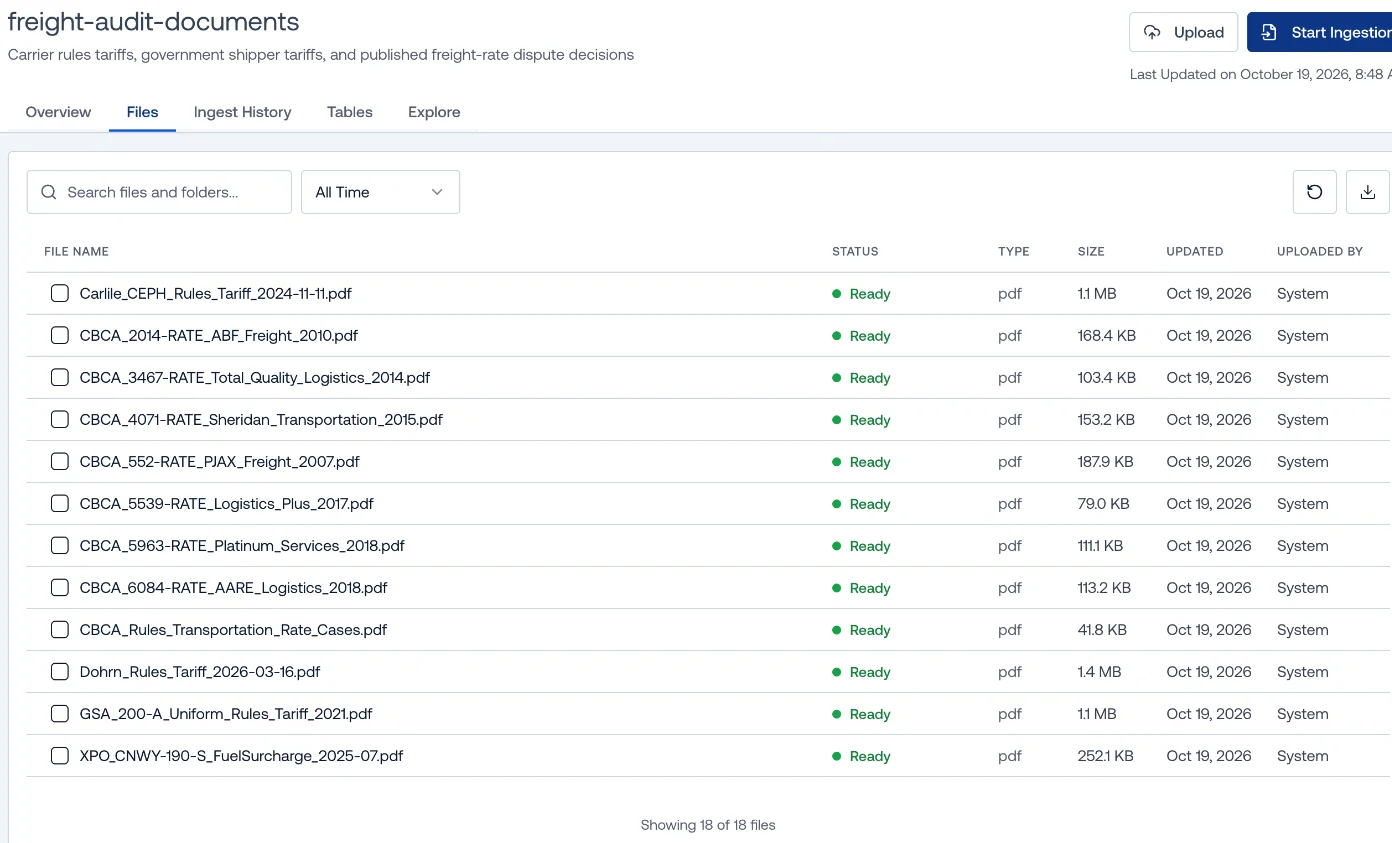
Eighteen public PDFs go into one data source: the GSA uniform tariff, four revisions of XPO's rules tariff with its rate guides and fuel surcharge table, the Dohrn and Carlile tariffs, and seven freight-rate decisions.

  • Create a data source.
  • Upload the PDFs.
  • Start ingestion.
Data sourcesIn the docs
The freight-audit-documents data source in Meibel: carrier rules tariffs, freight-rate decisions and the GSA uniform tariff, every file Ready.

Parse

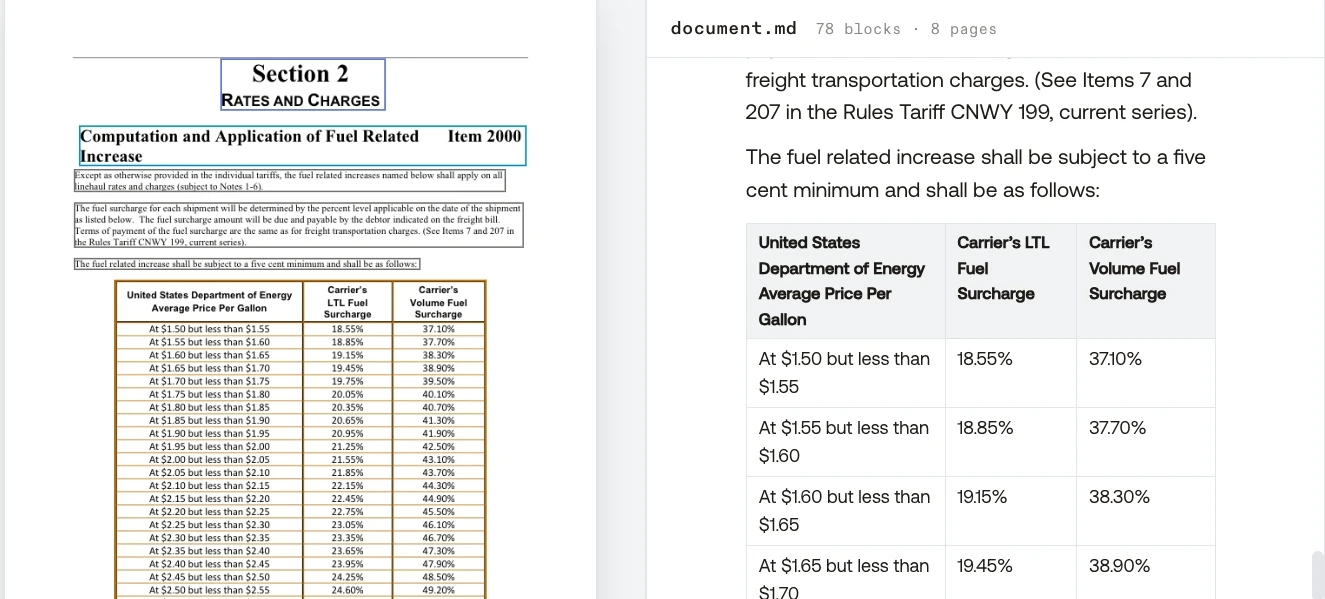
Tables stay tables.

Ingestion parses every page. A fuel surcharge table comes out as rows and columns, and every element keeps its place on the page, so an answer can cite it.

  • Nothing to configure.
  • Open any file to see the parsed page beside the original.
Extracting tablesIn the docs
An XPO fuel surcharge tariff page beside its parsed version in Meibel, with the surcharge table kept as rows and columns.

Schema

Decide what one record holds.

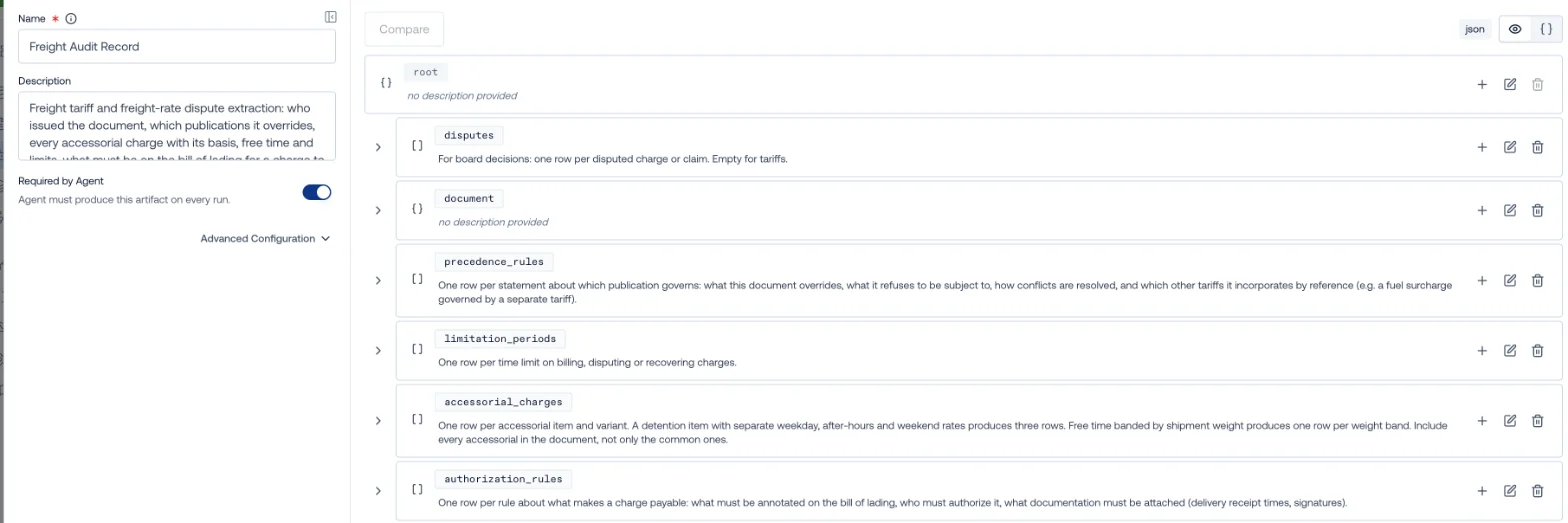
Every document becomes one freight audit record: which publication governs, every accessorial charge, the authorization rules, the limitation periods and any disputed charges.

  • Add a field for each thing an auditor checks.
  • Say what one row means in each description.

Tip"One row per weight band" is what keeps every rate next to its free time.

Prompts and schemasIn the docs
The Freight Audit Record schema in Meibel with fields for disputes, document, precedence rules, limitation periods, accessorial charges and authorization rules, each with a description of what one row holds.

Extract

The extractor reads one document at a time.

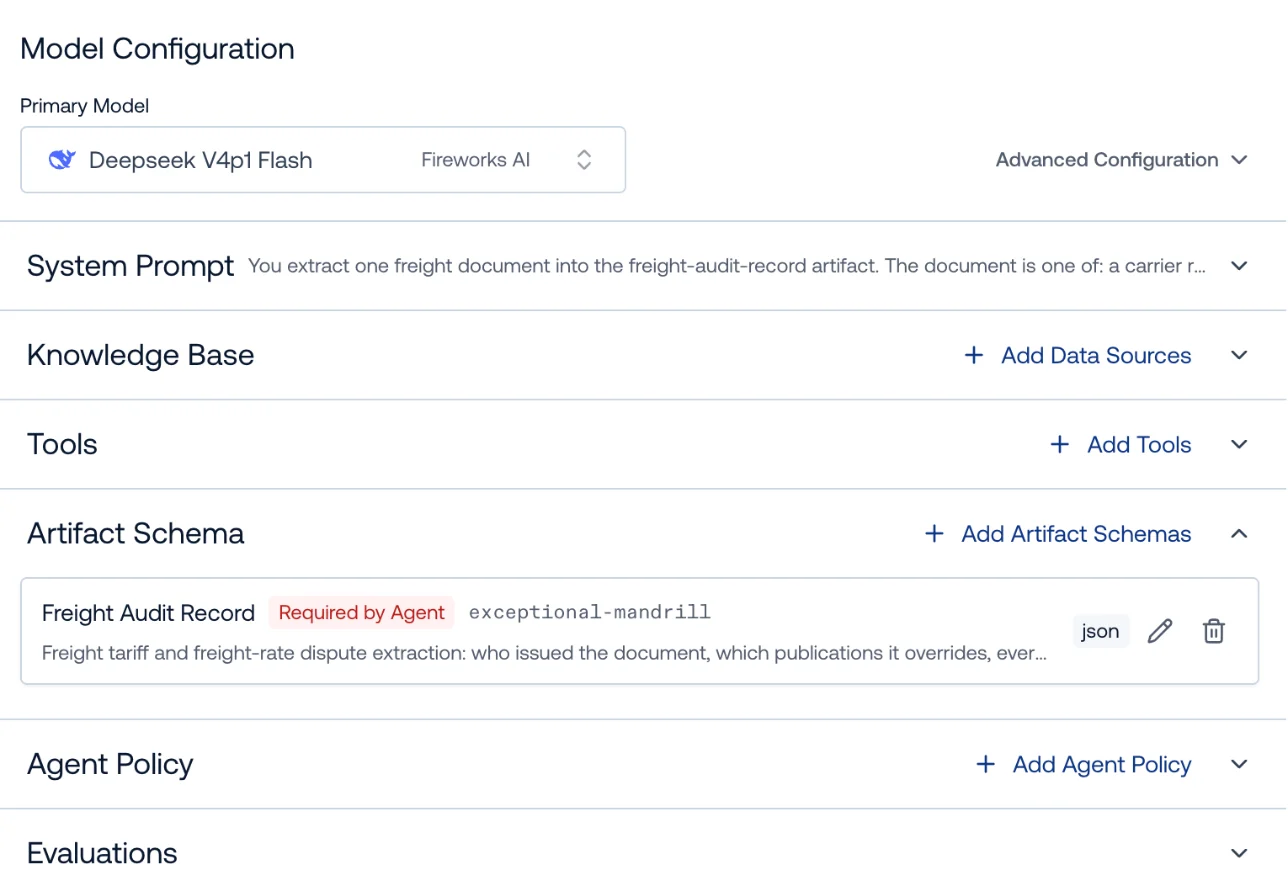
An extractor is an agent with the schema switched on as required and no data sources attached. It reads only the document it's given and returns one record.

  • Attach the schema and mark it required.
  • Leave the knowledge base empty.
  • Pick a fast model. This one runs DeepSeek V4p1 Flash.
AgentsIn the docs
The Freight Audit Extractor in the Meibel Agent Builder: DeepSeek V4p1 Flash, an empty knowledge base and the Freight Audit Record schema marked Required by Agent.

Batch

Run it on every document at once.

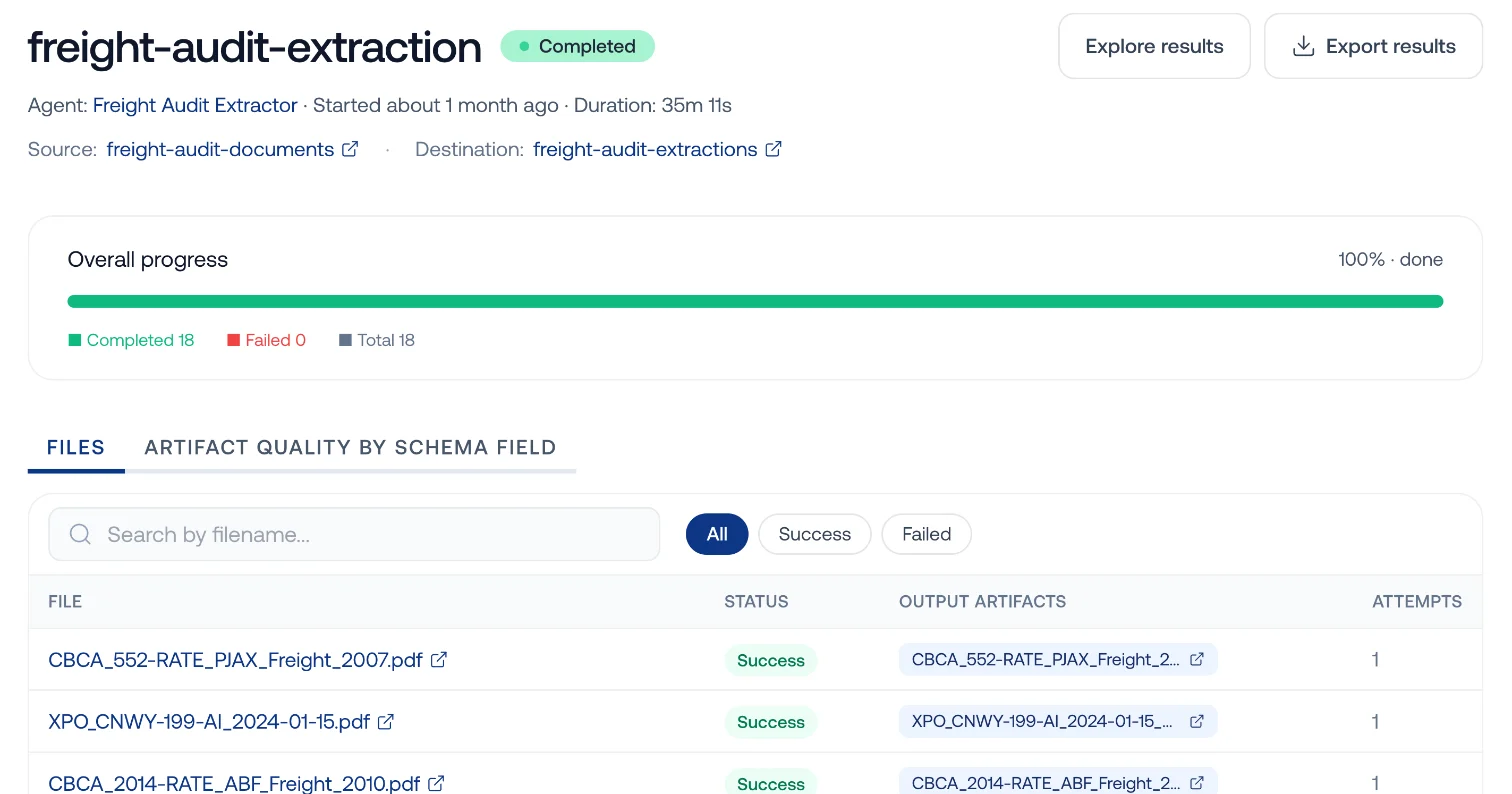
A batch runs the published extractor once per file and writes every record into a new table. Here: 18 of 18 files, none failed.

  • Choose the extractor and the documents data source.
  • Let Meibel create the output table.
  • Open the results as a table.
Batch jobsIn the docs
The freight-audit-extraction batch in Meibel: completed, 18 of 18 files, from freight-audit-documents into freight-audit-extractions.

Multiple data sources

Give the audit agent both.

The documents answer what the rule says and on which page. The table answers what the rate is, in every tariff and every revision. The agent searches one and queries the other.

  • Attach both in the knowledge base.
  • Tell it the order: governing tariff, then revision, then item.
Building agentsIn the docs
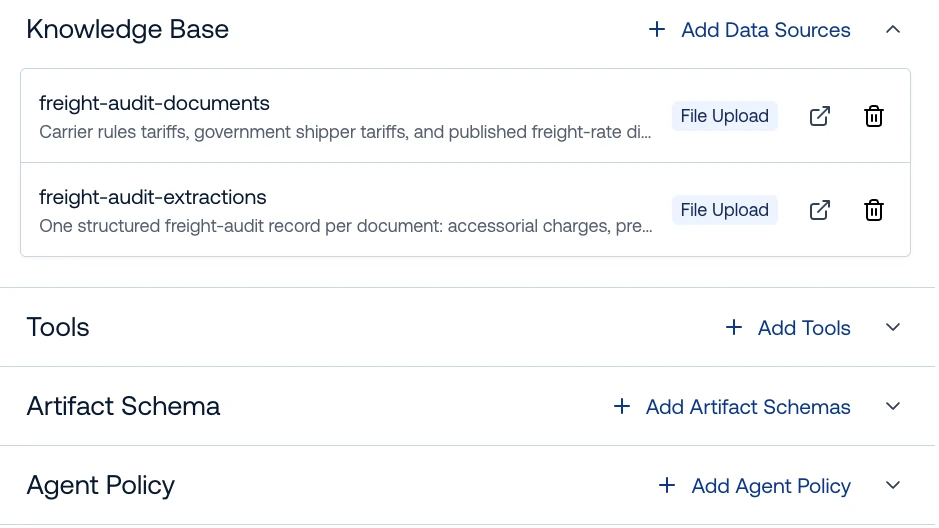
The Freight Audit Desk knowledge base in Meibel with two data sources: freight-audit-documents and freight-audit-extractions.
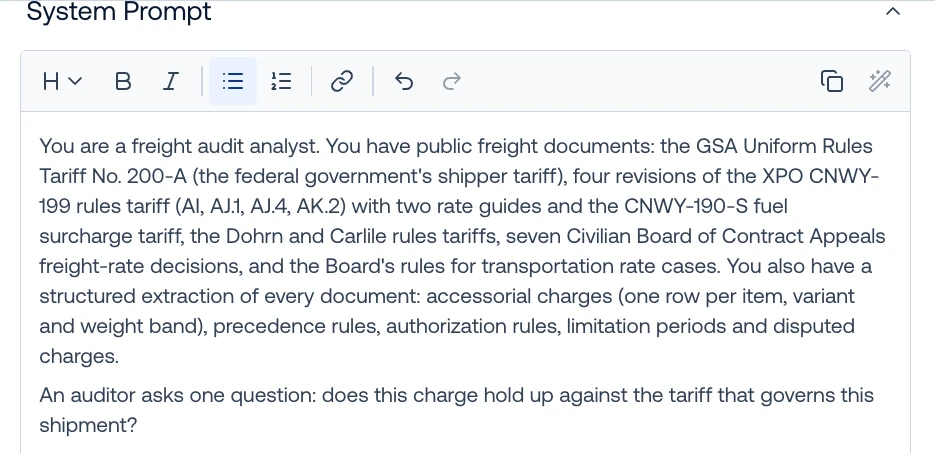
The Freight Audit Desk system prompt: a freight audit analyst with the GSA uniform tariff, four XPO revisions, the Dohrn and Carlile tariffs and seven Board decisions.

Confidence scoring

Choose what every answer is scored on.

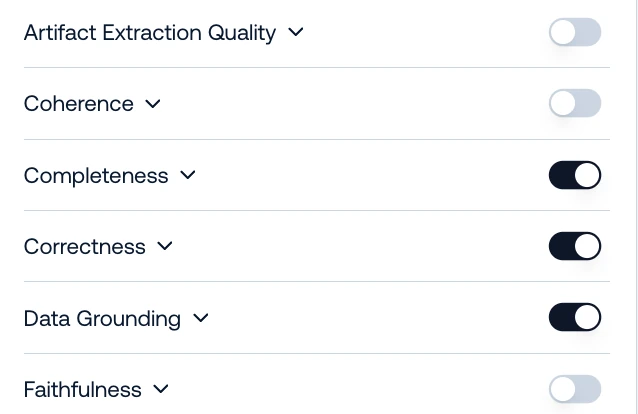
This agent is scored on completeness, correctness and grounding in its data. You choose the checks, and you decide what a low score triggers.

  • Switch on the checks that matter for an audit.
  • Read the scores on every answer in chat, the API or a batch.
Confidence scoringIn the docs
Evaluation checks in the Meibel Agent Builder with Completeness, Correctness and Data Grounding switched on.

Ask it

Same truck, same five hours.$82 owed, not $1,156.

One question from the build, answered by the Freight Audit Desk with the rule, the item and the page.

Freight Audit DeskOverall 8.0/10 · Data grounding 0.88

A truck delivered a 15,000 lb shipment to a federal site on a weekday in June 2026. It arrived at 8:00 a.m. and left at 1:00 p.m. The carrier is XPO and the shipment moved under a GSA tender. Which tariff governs the detention charge, and what is payable? Show what XPO's own tariff would charge for comparison.

GSA 200-A governs; charge = $82.00 (8 × $10.25). XPO's own CNWY-199 tariff would bill $1,156.00 for the same stop.

GSA 200-A (governs)XPO CNWY-199-AK.2 (comparison only)
Governing rule§1.2: tenders cannot be made subject to any other publicationSuperseded for this shipment
Item325-N, Detention, vehicles with power, p. 38Item 211, Detention With Power, p. 34
Weight band10,000 to 19,999 lb: 180 min free10,000 lb or more: 60 min free
Billable time120 min = 8 × 15-min units240 min = 16 × 15-min units
Rate$10.25 per 15 min$72.25 per 15 min
Charge8 × $10.25 = $82.0016 × $72.25 = $1,156.00

It answers the other three questions the same way

What changed between XPO's AI and AK.2 tariffs?Detention with power went from $65.25 to $72.25 per 15 minutes, with every other changed charge listed.
Was the charge authorized?PJAX was denied: nothing annotated on the bill of lading. TQL was upheld: GSA's transportation division authorized it.
Which clock applies?GSA has three years to deduct. The 180-day limit governs shippers starting a dispute.

Run it on every bill

Refine it on one shipment.Run it on every invoice.

Publish the agent and point a batch at a month of invoices, or call it as an MCP tool from the system your invoices live in. You decide what a low score sends to a person.

Make it yours

Swap in your tariffs.Keep the steps.

Your documentsYour carriers' rules tariffs, your tenders and contracts.
Your recordAdd the fields your audit checks, such as fuel tables or liability limits.
Your measureRun a month you've already audited. Compare what it caught, what it missed and the cost per invoice.

Try Meibel

Build the audit agent.Start with your own tariffs.

Load a few tariffs, shape the record and ask your first question.

  • Documents parsed, tables kept.
  • One record per document.
  • Two data sources, one agent.
  • Every answer scored and sourced.

Questions

What teams ask first.

Do I need the extraction step?

No. An agent can search the parsed documents directly. The table makes every rate queryable across every tariff and revision at once, which is what an audit at volume needs.

Can I use my own tariffs and invoices?

Yes. Upload your carriers' tariffs, your tenders and your invoices, and change the schema to the fields your audit checks.

Which models does it use?

Any model. Here the extractor runs a fast model and the audit agent a stronger one. LLM costs are at cost.

How do I know an answer is right?

Every answer cites the item and page, and is scored on the checks you choose. You decide what a low score triggers.

PALETTE